A Medallic Aureus of Augustus
After stating that the Romans preferred
their own down-to-earth realism to Greek idealism, it seems odd to
begin with the most idealized portrait of the Roman ruler who most hid
his own personality behind a mythic, never-aging, idealised mask.
This amazing portrait, on an excessively rare coin,
demonstrates that if it had been the Roman intention to depict their
rulers as a race of demi-gods, they were certainly capable of doing so.
This beautiful sensitive portrait shows the gentle,
thoughtful oversight of a kindly master – remote, but not uncaring – a
masterpiece of Greco-Roman art.

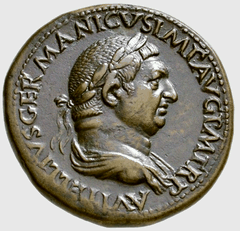
A Sestertius of Vitellius
Though a
successful general in Germany, Aulus Vitellius was by nature a weak
man, and when the tumults which followed the murder of Nero thrust him
to the summit of power, he gave way to the gluttony and vice from which
he could not restrain himself. The artists who worked on his
portrait attempted to produce the image of bull-necked strength, but
frequently the result was a jowly, weak-chinned portrayal of
self-indulgence – a true depiction of the man.
An Aureus of
Gordian III
The tumults of the year 238 A.D. saw six
men wearing the imperial purple, whether individually or in pairs, each
claimed legitimacy for his claim to power. And yet, the most
unlikely outcome of this year or turmoil was that the teenage
Gordian III would be accepted as the legitimate ruler at Rome and by
the armies, as the successor to his uncle and grandfather, the usurpers
from Africa. The boy-emperor managed to remain on his throne
for six year, and his portraits show an open-faced, innocent youth.
Perhaps the most charming of his portraits are those that
show him supporting a pair of downy, sparse sideburns and a fledging
moustache – like many young men, sensitive of their youth, he sought to
hasten the outward, visible signs of manhood.


A
Bronze Follis of Diocletian
As the more politically free days of the
Republic and early Empire passed away to be replaced by the military
domination of the late Roman period, so the style of portraiture on the
coinage had to change as well. The office of the Augustus or
the Caesar became more important than the individual who wore the
purple; the Roman public no longer interacted with their rulers, and
they might never see the remote general fighting on distant frontiers.
So, a new style began to emerge in which the coins bore a
bull-necked portrait of an idealised military leader, an unvarying
emblem, with only the changing legends identifying the individual
ruler.
Yet, even here the portraiture develops an almost Art Deco
minimalist charm.
An
Aureus of Postumus
Of this founder of the breakaway rebel
empire based in Gaul, we have
very little reliable history. Yet his coinage is of remarkable quality,
especially when compared to much third-century production, and the most
remarkable coin of all is this wonderful piece with its three-quarters
facing bust. Facing portraits were a very rare feature on
Roman coins: the greater skill needed to render a facing portrait
rather than a profile, and the greater damaged caused to the prominent
features of a facing bust by worn dies, so-called flat strikes, and
simple wear and tear, led most emperors and their moneyers to prefer
the traditional side-facing portraits – a choice that continues
today. The innovation in this choice of portrait, and the
skill demonstrated in its execution, shows a sensitivity that places
the die-engraver amongst the greatest artists of ancient
Rome. The portrait shows Postumus with a combination of
gentleness and strength, optimism and force of personality, that must
have delighted the ruler who commissioned this coin. This
coin is unique, as is the only other coin of this ruler with a similar
facing portrait, both were probably medallic in intention, minted for
distribution to his elite commanders; it was pierced in antiquity for
wearing as a piece of jewellery.


A
Bronze Sestertius of Maximinus Thrax
The middle years of the third century
saw the role of emperor become open to many contenders as victorious
generals emerged briefly from the shadows, exerting just enough
influence to be able to wrest some cohesion from the tumultuous forces
that characterised the age, and surviving long enough to be recognised
in at least part of the empire as 'the' Emperor. Soon
however, the tide of events changed, and rival claimants were swept
forward, and the previous occupant of the throne was pulled
down. Such, in summary is the story of Maximinus, a native of
Thrace, and who is this known to history as 'Thrax' – the
Thracian. With his long jaw, and strong, prominent features,
his portraits present an almost Desperate Dan-ish quality, far-removed
from the patrician-hauteur of the noble families of the City of
Rome. Yet the portraits show him for what he is, a successful
military man, strong, self-reliant, and confident of his own qualities
– the type of emperor that his times required, and one of many such who
would rise to the purple through their military triumphs.
Maximinus only survived at the pinnacle of human power for three years,
until displaced and killed in the usurpations of 238 A.D.
that ultimately saw the young Gordian arise as his eventual successor.
A
Bronze As of
Agrippa
The emperor Augustus, for all his
political genius, was no general, so
perhaps the greatest or wisest act of his career was to gain the
loyalty of Marcus Vipsanius Agrippa. Agrippa was from a
humble provincial family, and so was unable to make a bid for the
purple on his own behalf, yet its was through his defeat of the forces
of Antony and Cleopatra at Actium in the East, and his defeat of Sextus
Pompeius amongst other victories in the West, that he was largely
responsible for winning the Empire for his friend. On this
coin he wears a 'rostral' crown of interlinked ship's prows betokening
his naval victories. His force of character shines through
this wonderful depiction: strength, determination, and fearless courage
can all be seen in the pugnatious set of the chin and the beetling
brows. It could be said of Agrippa, as it was said by a later
observer of the American general U.S. Grant, that: "he habitually wore
an expression as if he had determined to drive his head through a brick
wall and was about to do it."


The
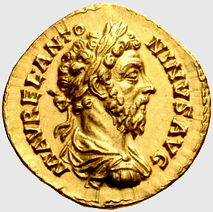
Aurei of Marcus Aurelius
The teenage Marcus Aurelius, a distant
relative of the emperor Hadrian,
was adopted by Antoninus Pius when Antoninus was himself adopted as his
heir by the aging Hadrian. In 140, at the age of 18, he
shared the consulship with Antoninus, and from then on was associated
in the reign of the Emperor as Caesar. He shared the throne
until Antoninus passed away in 161, and then reigned, either in his own
right, or with either his adopted brother, Lucius Verus, or his son,
Commodus, until his death in 180. Therefore, Aurelius has his
hands on the reins of power for 40 years, and the strain of those
years are reflected in his changing portraits. The stoic
philosopher-emperor may have found justification and satisfaction in
his career of public service, but hardship of his life defending his
empire on the frontiers during the latter part of his reign can be
seen.
The innocent and callow portraits of the boy who was chosen
to share power with the Antonine emperors faded; the beard, which the
adherent of Greek philosophy cultivated, grows longer, and the cheeks
which it covers grow sunken, and the eyes that were once bright, deepen
and appear heavy and tired — noblesse
oblige.


The
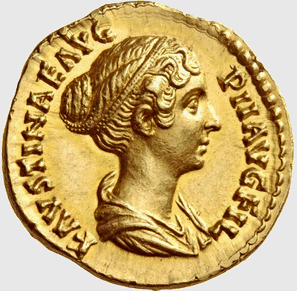
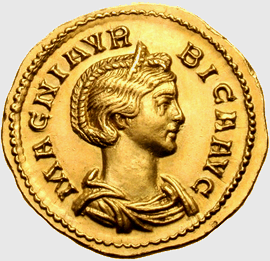
Empresses of Rome
By contrast with the austere, masculine
world of the Roman Republic,
the dynastic basis of Imperial Rome demanded a much more prominent role
for the female members of the ruling families. Livia, the
wife of Augustus, the first emperor, may have adopted the
stern, withdrawn, appearance of a traditional Roman matron, but her
successors were much more prominent. Empresses could be both
the guarantors of Imperial succession, by producing children, or the
instruments of the transfer of Roman power to the husbands whom they
married. Either way empresses and princesses enjoyed a degree
of publicity and political influence that their traditional
predecessors could never dream of, and these women were deeply
conscious of both their appearance and the attention paid to it by
woman across the Empire. It might seem odd to talk about
fashion when discussing the Roman world, but Roman women were deeply
conscious of being en
vogue, and wary of appearing in public wearing "last
year's" fashions. The necessity of maintaining
appropriate decorum meant that it was impossible for hemlines to rise
and fall or cleavage to plunge of women's costumes, but instead
hairstyles rose and fell, hair was swept up into buns or plaits, or
sculpted into elaborate rows or plaits across the head.
Diadems or tiaras varied in size and prominence, as did the
way they were worn in the hair, and the wearing of jewellery changes
from a discrete display of tasteful wealth to the portraits of the late
Roman empresses where the wife of the semi-divine ruler is literally
encased in gold and jewels – a living icon. And how much did
these Royal ladies care about being fashionable? Well,
statues and portrait busts of the empresses were frequently made with
detachable hair-pieces, so that, as fashions and styles changed, a new
hair-piece could be carved and fitted into the existing sculpture, and
the Imperial ladies need never go out of fashion.


A Sestertius of Vespasian
Following
the murder of Nero, the last of the Julio-Claudian descendants of
Augustus, a rapid succession of rival claimants made bids for the
throne, and were equally quickly rejected again. Eventual
success
fell to the greatest general of the age, Vespasian. This
career-soldier had conquered the south coast of Britain and the Isle of
Wight under Claudius, and, under Nero, he and his eldest son Titus had
been busy subduing the Jewish revolt and bringing the province of
Judaea back into the Empire. Vespasian came from equestrian
stock
from rural Italy, and was disdainful of the pretentions of the urban
elite and the traditional, aristocratic Roman families. His
down-to-earth bluntness can be clearly seen in his portraits, which
lack the patrician nobility which the Claudian family had assumed.
Her is seen the hands-on military man, who sought to
bring
benefits to the Roman world through a balanced budget, rather than seek
aggrandizement through expensive works; the clear-eyed, self-reliant
warrior who self-mockingly declared on his death-bed: "Dear me, I think
I'm becoming a god."
A
Bronze Medallion of Commodus
Commodus, the natural son of Marcus
Aurelius and Faustina, followed his father onto the throne, and, in
so-doing, broke the sequence of the adoptive, "good" emperors under
whom, as Gibbon stated, "the human race was most happy and prosperous."
Commodus, however, was a megalomaniac, who saw himself as
divine, frequently having himself portrayed wearing a lion's skin as
the new Hercules, or who, as the new Romulus, ritually re-founded Rome
and changed its name to Colonia
Commodiana. This remarkable bronze medallion
shows a portrait of chilling intensity and coldness; the face gives an
overall impression of impassive cruelty, whilst the slightly bulging
eyes betray an egotism so pure that it would sacrifice the Empire, all
its resources, and all its inhabitants to fulfil its deluded ambition.
His inevitable assassination, as with that of Nero 125 years
earlier, plunged the Roman world into a period of Civil War that was
only settled on the arrival of the Severan dynasty.


Looking
the Emperor in the Eye . . .
As I stated above, facing portraits were
rare on Roman coins, it is
therefore all the more inexplicable why, around the beginning of the
4th century, a group of emperors all chose to have themselves depicted
this way. One possible explanation may lie in the stronger
visual impact these portraits had, and the greater sense of importance,
or presence, that these images conveyed; this sense of the ruler
looking his subjects in the eye. Seeing the Emperor
face-to-face, rather than the conventional side-profile, forces the
viewer to process the experience in a different way. All
these coins are rare and were probably minted for distribution to
comrades and followers who would appreciate the connection.
First of this group of portraits is and extremely rare bronze coin of Carausius (upper left), who used his command of the fleet to seize the island of Britain and hold it against Maximian and Constantius. The self-confidence to usurper felt is nowhere more clearly seen than in this facing portrait.
Facing portraits of Constantine are incredibly rare, but this worn aureus (upper right) offers a wonderful depiction of the man who re-unified the Empire: he holds a globe in his hand, and his head is surrounded by a glowing nimbus demonstrating his allegiance to his patron deity, not Jesus Christ, whose religion he did so much to promote, but his "Companion", the "Unconquerable Sun" – Soli Invicto Comiti.
Constantine's first great rival in his bid for power was Maxentius, the son of the former Tetrarch Maximian. Maxentius had seize Rome and Italy from the current Tetrarchs as he sought to establish himself as the legitimate successor to his father. His facing-portrait coins (middle left) show him with a look of brooding menace as he gazes straight at you from under scowling brows. His usurpation was initially welcomed at Rome, but warmth soon gave way to hatred as his harsh rule and personal vices turned the population against him.
Initially Constantine shared his empire with Licinius, and he advanced his son, also called Licinius, to the rank of Caesar, just as Constantine had promoted his own three sons. The facing portraits of the pair (middle and lower right) may have striven for an image of dynastic strength, but the portrayals the Imperial die-makers produced tended towards a look of cross-eyed bewilderment, a not unfitting memorial of a dynasty that died aborning, and a rival that came to terms with the ruthless and relentless ambition of Constantine.
The final coin of this group is of Constantius II (lower left), the only son of Constantine to enjoy a long reign and his true heir. This three-quarter-facing portrait adumbrated the style of portraiture that would become standard for the 5th century emperors on their gold solidi, and pave the way for further developments in stylised depictions of Byzantium.
First of this group of portraits is and extremely rare bronze coin of Carausius (upper left), who used his command of the fleet to seize the island of Britain and hold it against Maximian and Constantius. The self-confidence to usurper felt is nowhere more clearly seen than in this facing portrait.
Facing portraits of Constantine are incredibly rare, but this worn aureus (upper right) offers a wonderful depiction of the man who re-unified the Empire: he holds a globe in his hand, and his head is surrounded by a glowing nimbus demonstrating his allegiance to his patron deity, not Jesus Christ, whose religion he did so much to promote, but his "Companion", the "Unconquerable Sun" – Soli Invicto Comiti.
Constantine's first great rival in his bid for power was Maxentius, the son of the former Tetrarch Maximian. Maxentius had seize Rome and Italy from the current Tetrarchs as he sought to establish himself as the legitimate successor to his father. His facing-portrait coins (middle left) show him with a look of brooding menace as he gazes straight at you from under scowling brows. His usurpation was initially welcomed at Rome, but warmth soon gave way to hatred as his harsh rule and personal vices turned the population against him.
Initially Constantine shared his empire with Licinius, and he advanced his son, also called Licinius, to the rank of Caesar, just as Constantine had promoted his own three sons. The facing portraits of the pair (middle and lower right) may have striven for an image of dynastic strength, but the portrayals the Imperial die-makers produced tended towards a look of cross-eyed bewilderment, a not unfitting memorial of a dynasty that died aborning, and a rival that came to terms with the ruthless and relentless ambition of Constantine.
The final coin of this group is of Constantius II (lower left), the only son of Constantine to enjoy a long reign and his true heir. This three-quarter-facing portrait adumbrated the style of portraiture that would become standard for the 5th century emperors on their gold solidi, and pave the way for further developments in stylised depictions of Byzantium.


On
the Fringes of Empire . . .
It was not only the empresses who
exhibited vanity or took pains over
their appearance. As noted above, Julius Caesar welcomed the
opportunity afforded of wearing a laurel wreath to hide his balding
pate. The short-lived emperor Otho (left), who came to power
in 69 A.D. after the murder of Nero, had no need to adopt such a
stratagem, and was never shown wearing such an ornament.
Instead, though bald on top when he ascended to the throne,
he hid this embarrassing feature beneath an elegant wig of tight,
tufted curls. Resembling the wigs worn by judges and
barristers in British courts, it can be clearly seen on his coin
portraits, and its ordered, static coiffure is in contrast to the more
natural curls of his remain hair, which is shown lower on the back and
sides of his head.
The emperor Gordian II (right), uncle of Gordian III above, felt no such embarrassment over his own receding hairline, and though always depicted wearing a laurel wreath, it is never positioned to hide this prominent feature. Gordian alongside his father, Gordian I, ruled briefly during the disorder of 238 A.D., and although the two men shared identical names, titles, and coin-types, the issues of the younger man can always be identified by the shining dome of his "high" forehead.
The emperor Gordian II (right), uncle of Gordian III above, felt no such embarrassment over his own receding hairline, and though always depicted wearing a laurel wreath, it is never positioned to hide this prominent feature. Gordian alongside his father, Gordian I, ruled briefly during the disorder of 238 A.D., and although the two men shared identical names, titles, and coin-types, the issues of the younger man can always be identified by the shining dome of his "high" forehead.
