
by H Mattingly & EA Sydenham et al.
Probably the greatest source of information on Roman coins available. The earliest volumes are now out of date, but are gradually being replaced. A full set will now cost over £800, but no other publication, since Cohen's great catalogue, has set out to describe the entire corpus of Roman imperial coins.
Vol. I. Augustus to Vitellius (rev. edition)
Vol. II. Vespasian - Hadrian.
Vol. II, part 1. Vespasian - Domitian (2nd rev. edition)
Vol. III. Antoninus Pius - Commodus.
Vol. IV. Pertinax - Uranius Antoninus, 3 parts in 1 vol.
Vol. V, part 1. Valerian - Florian; part 2. Probus - Amandus
Vol. VI. Diocletian - Maximinus
Vol. VII. Constantine - Licinius
Vol. VIII. Family of Constantine
Vol. IX. Valentinian - Theodosius I
Vol. X. Honorius and Arcadius - Romulus Augustus
by H Mattingly et al.
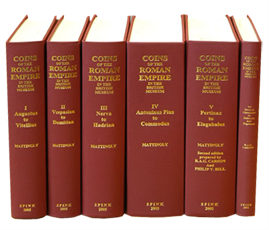
Published over a period of 40 years this set intended to document in detail the incredible collection of the British Museum. However, the project faltered with the publication of the sixth volume culminating with the brief reigns of Balbinus and Pupienus. The set has been revised and reprinted, and every effort has been made to ensure that the tremendous quality of the prints was maintained, and so they remain one of the greatest resources available to students of the numismatics of the early empire.
Vol. 1. Augustus to Vitellius (1923)
Vol. 2. Vespasian to Domitian (1930)
Vol. 3. Nerva to Hadrian (1936)
Vol. 4. Antoninus Pius to Commodus (1940)
Vol. 5. Pertinax to Elagabalus (1950)
Vol. 6. Severus Alexander to Pupienus (1963)


J-B Giard, et al.
The ongoing publication of the great French National Collection from Paris. The descriptions are meticulous and every coin in illustrated on high quality plates.
Vol. 1. Auguste (1976)
Vol. 2. De Tibère à Néron (1988)
Vol. 3. Du soulèvement de 68 ap.JC à Nerva (1998)
Vol. 4. Trajan (2008)
Vol. 17. Aurélien, Tacite et Florien (2004)
by Henry Cohen (Paris, 1880-92)
Dated in arrangement, but still astounding in scope and comprehensiveness: covering the late Republic to the contorniates of the 5th centrury. The arrangement is by reverse legend under each ruler; a choice that is frowned on by numismatists, but is still useful to collectors. The set can be purchased as an excellent Forli reprint, or downloaded in pdf format from Internet Archive.
Tome I. de Pompée à Domitien (67 avant J.-C. à 96 après J.-C.)
Tome II. de Nerva à Antonin (96 à 161 après J.-C.)
Tome III. de Marc Aurèle à Albin (161 à 197 après J.-C.)
Tome IV. de Septime Sévère à Maxime (193 à 238 après J.-C.)
Tome V. de Gordien Ier à Valérien II (238 à 268 après J.-C.)
Tome VI. de Post. à Maximien Hercule ( c. 258 à 310 après J.-C.)
Tome VII. de Carausius à Constance II (c. 287-361 après J.-C.)
Tome VIII. de Népotien à Romulus Augustule (c. 350-475 après J.-C.)


by Anne S Robertson
A profusely illustrated and comprehensive catalogue of one of the most important coin collections in Britain. The Hunter collection often contains specimens that fills gaps in the B.M. collection. However, the volumes are now out-of-print and command large prices when offered at second hand.
Vol. 1. Augustus to Nerva (1962)
Vol. 2. Trajan to Commodus (1971)
Vol. 3. Pertinax to Aemilian (1977)
Vol. 4. Valerian to Allectus (1978)
Vol. 5. Diocletian (reform) to Zeno (1982)
HA Seaby, et al.
A curious catalogue which has become, somewhat unfortunately, a standard reference. Based upon the arrangement of Cohen, but with additions and corrections, RSC has a value, but is poorly illustrated, and ignores the base-metal 'silver' coinage of the late third and fourth centuries.
Vol. I. Republic to Augustus (1978)
Vol. II. Tiberius to Commodus (1979)
Vol. III. Pertinax to Balbinus & Pupienus (1982)
Vol. IV. Gordian III to Postumus (1982)
Vol. V. Carausius to Romulus Augustus (1987)


Davis R Sear
Amateur collectors need look no further than these excellent volumes. The Millenium Edition replaces the original single volume work with a new multi-volume format. Sear illustrates the whole range of coinage issued in each period, and includes references to standard works; and the whole is well illustrated and has discussions throughout on points of numismatic or historical interest.
Vol. 1. The Republic and the Twelve Caesars, 280 BC - AD 96 (2000)
Vol. 2. The Accession of Nerva to the Overthrow of the Severan Dynasty, AD 96 - 235 (2002)
Vol. 3. The Accession of Maximinus I to the Death of Carinus, AD 235 - 285 (2005)
Vol. 4. Tetrarchies and the Rise of the House of Constantine: The Collapse of Paganism and the Triumph of Christianity, Diocletian to Constantine I, AD 284-337 (2010)
Vol. 5. The Christian Empire: the Later Constantinian Dynasty and the Houses of Valentinian and Theodosius and Their Successors, Constantine II to Zeno, AD 337 - 491 (2014)
X Calicó (Barcelona, 2003)
Describing and illustrating 5,200 Roman gold aurei, and includes a rarity guide and concordance. A high quality work which makes available a large body of material. If it has any faults they lie in the over-reliance on the testimony of Cohen for some entries, and the inclusion of illustrations of denarii where pictures of aurei were unavailable. However, these are minor criticisms of a valuable work.
Vol. 1. The Republic to Pertinax. 196 BC - 193 AD
Vol. 2. Didius Julianus to Constantius I. 193 AD - 335 AD

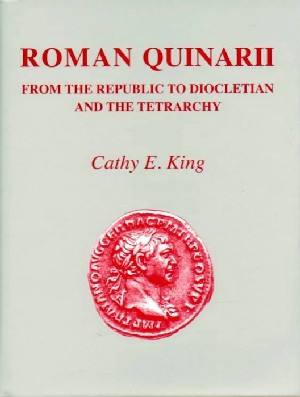
Cathy E King (Oxford, 2007)
A remarkable and valuable catalogue of all known specimens of this rare denomination. The location and weight of each specimen is given, and all issues, and many examples of each issue, are illustrated. The illustrations could perhaps be of higher quality, but that would be nit-picking.
Juan R. Cayón (Madrid, 1984)
A good effort to cover perhaps the most artistically diverse denomination of Roman coins, and the volumes contain many illustrations of rare types. However, the arrangement too slavishly follows Cohen, and fails to correct even the most obvious errors in description. It also makes errors in understanding Cohen's descriptions, e.g. failing to distinguish between Cohen's use of 'head' or 'bust' on the obverse.
Vol. I. de Pompeyo Magno a Matidia
Vol. II. De Adriano a Faustina Madre
Vol. III. De Marco Aurelio a Caracalla


David L. Vagi (Chicago and London, 1999)
Very much a work of two halves; the history side is excellent, and provides a high-quality historical summary of the reigns of each of the emperors, giving context to the production of the coins. It is harder to find justification for the second volume, which provides a rough summary of the denominations and types of the most common issues for each reign, and broad valuations. It is difficult to see how either series students or collectors would use this volume.
Vol. 1. History
Vol. 2. Coinage
David Van Meter (New York, 1991)
Perhaps the best single volume guide for beginners and small collectors. This volume provides a comprehensive guide to the history, types and range of coins available for each entry. The valuations are quirky, coins are given a 'value band', but this at least means that the prices are not rendered redundant by inflation as the relative values of different coins will remain roughly correct,


Carmen Alfaro Asins (Madrid, 1993)
A well presented catalogue of the small, but valuable, collection of ancient gold coins in the Madrid collection. The volume is let down, however, by the small and grainy quality of the black and white illustrations, with only a handful of the pieces being depicted on colour photographic plates.
Philip V. Hill (London, 1989)
A fascinating monograph developing a study originally published in Numismatic Chronicle. Hill combines the numismatic evidence with archeology and historical sources to illustrate both the surviving and the lost Roman monuments.


Clive Foss (London, 1990)
This book provides a brief outline of the historical events in the reigns of each emperor and attempts to identify the legends and types which refer to them. Some may question the choices made in deciding what constitutes a constitutes a typological trope of the coinage, and what a genuine response to current events.
Philip V. Hill (London, 1970)
A serious attempt to give order to the coinage of Rome from the accession of Trajan to Antoninus Pius' decision to date his coinage by the years of his holding the tribunicia potestas.


R.A.G. Carson, J.P.C. Kent and P.V. Hill (London 1978)
A catalogue detailing the arrangement and freuently bewildering variety of types and mint-marks to be found on late-Roman bronzes. An exceedingly valuable resource for collectors and students.
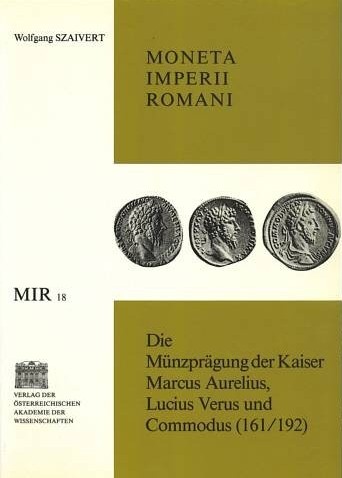
Wolfgang Szaivert (Vienna, 1989)
Volume 18 of the MIR project gives a detailed analysis of the types, arrangement and dating of the successive issues of the later Antonine emperors.

Paul L. Strack (Stuttgart, 1931-37)
A detailed catalogue listing every issue known to Strack, and even detailing which obverse bust variety are found for each reverse type. Strack also gives provenences for his listings from known specimens in public collections, and sources of illustrations from published catalogues. He provides concordances to Cohen, Gnecchi and RIC, and a detailed commentary on doubtful, hybrid or misdescribed listings in other sources. Numismatics may have moved on since the Strack published, but not that far; these volumes remain indespensible to any serious student of second-century numismatics.
Vol. 1. Die Reichsprägung zur Zeit des Traian
Vol. 2. Die Reichsprägung zur Zeit des Hadrian
Vol. 3. Die Reichsprägung zur Zeit des Antoninus Pius