The Adoptive and Antonine Emperors
(A.D. 96 - 192)


NervaNerva          (A.D. 96 - 98)
A supporter of Nero, and colleague of both Vespasian and Domitian, the aging senator Marcus Cocceius Nerva was in his late sixties and infirm when selected by the Senate to replace the murdered Domitian. They hoped that rule of ‘one of their own’ would restore the damage of done by the autocratic Flavians, and indeed Nerva’s reign was marked by a desire for peace and stability. However, unrest and revolt among the soldiers showed how weak his position was, a desparate situation only remedied by the adoption of the general Trajan, the governor of Upper Germany, as his son, co-emperor, and successor.
TrajanTrajan         (A.D. 98 - 117)
A great military leader who secured the frontiers of the empire, and indeed, particularly in the East, expanded them to their greatest extent. He campaigned against the Dacians, north of the Danube, and added the province of Dacia to the empire. These campaigns are depicted on his famous column which still stands in Rome and once formed the centerpiece of his great Forum. His reign was one of peace and prosperity, for this reason he was referred to by his contemporaries and remembered by later Romans as the optimus princeps  - 'greatest of emperors.'
Trajan PaterTrajan Pater
The father of Trajan; he was the first member of his family to enter the Senate. He served Vespasian and Titus as a general, and was awarded with provincial governorships. He probably lived to see his son become Emperor.
PlotinaPlotina
The wife of Trajan; a highly educated women, who used her influence to promote improved education, relief for the poor, and fairer taxation. She was instrumental in the adoption of Hadrian as her husband’s successor.
MarcianaMarciana
The elder sister of Trajan, she was awarded the title of Augusta and became a leading part of the image of the royal family. She accompanied her brother on his journeys, and assisted in the policy-making process. She died between 112 and 114.
MatidiaMatidia
The daughter of Marciana and niece to the emperor Trajan. Like Marciana, Matidia featured prominently in the presentation of the Imperial family and travelled with the Emperor.   
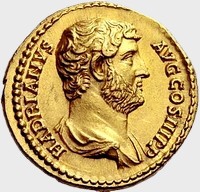
HadrianHadrian      (A.D. 117 - 138)
Born in Spain, and adopted by Trajan on his deathbed, Hadrian was an intellectual and cultured man, who was tireless in his maintenance of the Empire. He relinquished many of Trajan’s conquests in the Middle East, instead preferring to settle Rome’s boundaries on more easily defended frontiers. He was also responsible for establishing permanently manned frontier walls, particularly on the Rhine, and in northern Britain. A relentless traveller he visited all but three of the Roman provinces.
SabinaSabina
The wife of Hadrian, she had been raised in the house of Plotina. They had an unhappy marriage which produced no children. Sabina was strong-willed and independent, and her beliefs on marriage didn't sit well with the Emperor.
Lucius AeliusLucius Aelius
Adopted as Caesar by the aging Hadrian, Aelius had no military experience, but had powerful political connections. His health was poor, and his lifestyle luxurious and extravagant. His early death prevented his succession. He was the father of Lucius Verus.

AntinoüsAntinoüs
Born to a Greek family from Bithynia, he joined the entourage of Hadrian, and soon became his lover. He died in a drowning accident, and Hadrian was inconsolable; he named towns after the beautiful youth, and created countless images of him.

Antoninus PiusAntoninus Pius     (A.D. 138 - 161)
Antoninus won fame for his integrity whilst proconsul of Asia, and joined Hadrian’s inner circle of advisors. Before he died, Hadrian adopted him as his successor. Antoninus' struggles to ensure that his predecessor's deification, against the will of a reluctant Senate, earned his the cognomen 'Pius', that is loyal or dutiful. His reign was peaceful, orderly, and without major incident, his policies were kindly and progressive. He is responsible for the temporary expansion of Roman authority further into Scotland where the turf rampart between the Forth and Clyde still bears his name, but in contrast to his predecessor he hardly ever left Italy.
Faustina SeniorFaustina Senior
The daughter of a consul, she was happily married to Antoninus Pius and bore him two sons and two daughters. She was especially interested in sponsoring and assisting the education of Roman children, particularly Roman girls.
Galerius AntoninusGalerius Antoninus
Galerius Antoninus was the second son of Antoninus Pius and Faustina, but he had already died before his father became Emperor, and was buried in Hadrian’s Mausoleum at Rome. This coin is the only issue to bear his picture.
Marcus AureliusMarcus Aurelius             (A.D. 161 - 180)
Adopted by Antoninus as his successor in 138, Marcus Aurelius also married Antoninus’ daughter Faustina. Highly educated in Greek and Latin, his ‘Meditations’ show a deep attachment to stoic philosophy. Marcus Aurelius, ruling jointly with his adoptive brother, Lucius Verus, spent much of his reign fighting the Parthians in the East, and securing the weakened Rhine-Danube frontier. His biggest error was to return to hereditary succession rather than adopting a man of tried ability, and thus he became the last of the 'Five Good Emperors'.
Faustina JuniorFaustina Junior
The younger daughter of Antoninus Pius and Faustina Senior, she had been betrothed at Hadrian’s wish to Lucius Verus. At Hadrian’s death she was married to Marcus Aurelius, to whom she bore several children including Commodus.
Children of Marcus AureliusChildren of Marcus Aurelius
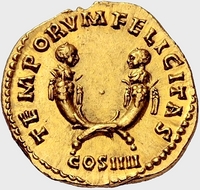
In 149 Marcus Aurelius and Faustina Junior produced twins: a boy Aurelius Antoninus, who died in infancy, and a daughter Lucilla, who survived to marry Lucius Verus. The births were commemorated on this coin of Antoninus Pius.
Lucius VerusLucius Verus        (A.D. 161 - 169)
Adopted alongside Marcus Aurelius by Antoninus Pius, when Aurelius became Emperor he insisted that Verus be made co-Emperor by the Senate, and they had equal authority, except that Aurelius was also Pontifex Maximus. A large part of his reign was spent campaigning against the Parthian Empire, though contemporary accounts say that Verus travelled in luxury surrounded by actors and musicians. He died from a stroke whilst campaigning alongside Aurelius on the Danubian frontier.

LucillaLucilla
Lucilla bore Lucius Verus three children: two daughters and a son. After Marcus Aurelius’ death she plotted against Commodus, and was executed on his orders whilst living in exile on Capri.

CommodusCommodus           (A.D. 177 - 192)
The eldest son of Marcus Aurelius, he began his reign well, trusting his father’s advisors and restoring peace to the Empire. However, a series of conspiracies, real or imagined, resulted in the execution of many of those with the ability to influence the young Emperor in a positive direction. This forced him to rely upon ‘favourites’ of uncertain ability and motivation. Late in his reign he became insane, believing himself to be the reincarnation of Hercules. Determined to appear in public as consul and gladiator, his ministers had him strangled by an athlete called Narcissus.
CrispinaCrispina
The wife of Commodus, their marriage had been arranged by their families. Commodus hated Crispina, and she was described as proud and haughty. Accused of adultery or treason, she was banished to Capri, and whilst there executed.
Annius VerusAnnius Verus
The younger son of Marcus Aurelius and Faustina Junior, he is shown on this medallion, on right, facing his older brother Commodus.  He apparently died in childhood.


Back