The Age of Crisis
(A.D. 235 - 268)
 
Maximinus I ‘Thrax’Maximinus I ‘Thrax’      (A.D. 235 - 238)
A Danubian soldier of relatively humble stock, he gained numerous senior appointments in the Severan army. After the assassinations of Severus Alexander and Julia Mamaea, the army proclaimed Maximinus to be Emperor, and their choice was accepted at Rome. His repressive measures led to the revolt of the Gordians in Africa. Maximinus was continually occupied with campaigns on the northern frontier, and never visited Rome. It was whilst marching on Rome to put down the rebellions that he was murdered by his own soldiers in Northern Italy.
Paulina
Paulina
The wife of Maximinus; next to nothing his known of her life or her eventual fate. All her coins are posthumous issues, so it is believed she died before, or very soon after, her husband’s accession.
MaximusMaximus
Considered handsome but lazy, Maximus accompanied his father on his military campaigns, and was raised to the rank of Caesar. He was with his father at the end and died at the hands of the mutinous soldiers.
Gordian I ‘Africanus’Gordian I ‘Africanus’          (A.D. 238)
In early spring 238, probably on 22 March, Gordian, the proconsul of Africa, was proclaimed Emperor at Thysdrus and associated his son, also called Gordian, in his rule as Augustus and co-Emperor. They were recognised by the Senate as joint Emperors, but their reign lasted only a few weeks before they were defeated and killed by the procurator of Numidia who had remained loyal to Maximinus.
Gordian II ‘Africanus’Gordian II ‘Africanus’         (A.D. 238)
The son of Gordian I who shared in the brief reign of his father as joint Augustus. Though he shared identical titles with his father on his coin, his portrait can always be distinguished by the receeding hair on his forehead.
BalbinusPupienusBalbinus and Pupienus         (A.D. 238)
When news of the defeat and death of the Gordians reached Rome, around 22nd April, the Senate chose two of its own members, Balbinus and Pupienus, as joint Emperors, and associated the young Gordian III, grandson of Gordian I, with them as Caesar. Even after Maximinus had been murdered by his troops at Aquileia, the two senatorial Emperors could not command the loyalty of the soldiers, and were murdered by the Praetorians some weeks later, and Gordian III was proclaimed emperor on 29th August.
Gordian IIIGordian III           (A.D. 238 - 244)
The grandson of Gordian I, and Caesar under Balbinus and Pupienus, Gordian III, a boy of thirteen, was proclaimed Augustus upon the death of the latter pair. Gordian was guided by the Praetorian Prefect Timesitheus. He led a successful campaign in the East to repel the Sassanian Persian invasion of Syria which saw the defeat of their leader Shapur I. Timesitheus died in the winter of 243-4 and was replaced by Philip. Philip fomented discontent in the army, and brought about Gordian’s assassination and his own subsequent proclamation as Augustus.
TranquillinaTranquillina
The beautiful and intelligent daughter of the Praetorian Prefect Timesitheus, she had a happy marriage to the boy-emperor Gordian III. She survived the death of Gordian and the accession of Philip, and beyond.
Julius MarinusJulius Marinus
The father of Philip I, he was a Roman citizen from Shahba, about 55 miles south-southeast of Damascus, in the Roman province of Syria. His provincial Syrian origins led to his son being referred to as ‘Arabicus’.
Philip I ‘the Arab’Philip I ‘the Arab’          (A.D. 244 - 249)
Of Syrian origin, Philip was Praetorian Prefect under Gordian and replaced him as Emperor. On accession he quickly arranged a peace with Persia, and returned to Rome accompanied by his son, Philip the Younger, whom he had made Caesar, and later advanced to the rank of Augustus. The Millennium of Rome was commemorated in 248 with celebrations and games. Later in the year there were military revolts in Moesia by Pacatian, and in Cappadocia by Jotapian, both of whom were soon killed. Philip sent Decius to restore order, but his success and popularity brought about his proclamation as Emperor, and after a march on Rome he defeated and killed Philip in battle at Verona.
Otacilia SeveraOtacilia Severa
The wife of Philip I, who she presented with two children. The Senate granted her the honorific title Augusta. She survived the death of her husband, and murder of her son, but the rest of her life is obscure.
Philip IIPhilip II
The son of Philip I, he was made Caesar soon after his father’s accession, and was advanced to the rank of Augustus during the triumphal celebrations that greeted their return to Rome after settling the East. Philip II was killed by the Praetorians.
PacatianPacatian
He headed a revolt in upper Moesia and had himself proclaimed Augustus; he issued coins to pay his soldiers and advertise his claim.
JotapianJotapian
The leader of a revolt that broke out in Cappadocia or, according to some historians, in Syria in 249. It was quickly put down, though news of the suppression did not reach Rome until Decius had succeeded Philip.
SilbannacusSilbannacus
A mysterious figure known only from two coins. His name appears to suggest a celtic origin, and he could have been a military commander in Germania Superior. His rebellion has been dated anywhere between the reigns of Philip I and Aemilian.
SponsianusSponsianus
A usurper believed to date to the reign of Philip I, and known only from a single gold coin found in Transylvania in 1713.

The coin pictured is a modern replica.
Trajan DeciusTrajan Decius                 (A.D. 249 - 251)
On arriving at Rome after defeating Philip, Decius was recognised by the Senate, and adopted the name Trajan after the emperor upon whom he intended to model himself. He aimed to restore unity to the Empire, and, as part of this plan, organised the first general persecution of Christians. His son Herennius Etruscus, now advanced to Augustus, was sent to deal with an invasion of Goths across the ice-bound Danube, Decius soon followed; lured perhaps into a rash advance by his lieutenant, Trebonianus Gallus, both the Emperor and his son were killed.
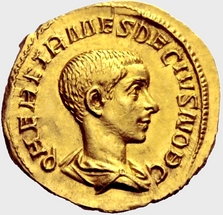
Herennia EtruscillaHerennia Etruscilla
Probably of senatorial family, she became regent for her son Hostilian after her husband, Trajan Decius, and son, Herennius, were defeated and killed in the Battle of Abrittus. She sank into obscurity after her last surviving son perished.
Herennius EtruscusHerennius Etruscus
The son of Trajan Decius, he was probably made Caesar upon his father’s accession, and elevated to Augustus shortly before leaving Rome to fight the Goths in 251. He died in battle alongside his father.
Trebonianus GallusTrebonianus Gallus        (A.D. 251 - 253)
Upon the deaths of Decius and Herennius Etruscus, Trebonianus Gallus, the governor of Moesia, was proclaimed Emperor by his troops. He arranged a treaty with the Goths, and hurried back to Rome. The short reign of Gallus was a succession of disasters: a plague ravaged Rome and Italy, whilst in the East the Sassanians made forays as far as Antioch, and the Goths again invaded across the Danube. A successful stand against the Goths by Aemilian led to him being proclaimed Emperor by his troops. He invaded Italy and killed Gallus in battle.
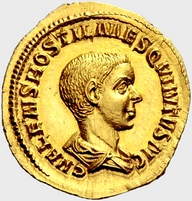
HostilianHostilian
The surviving son of Decius, he was raised to Augustus by Gallus. He died in the plague of Rome.
VolusianVolusian
The son of Trebonianus Gallus, he was made Caesar at the same time as Hostilian was made Augustus. Upon the death of Hostilian he was advanced to Augustus. He died in battle alongside his father.
AemilianAemilian                (A.D. 253)
It is not certain when Aemilian was proclaimed by his troops, but he was recognised in Rome after defeating Gallus and Volusian in battle. His reign lasted only three months. Valerian, who had been sent by Gallus to gather reinforcements, was himself proclaimed Emperor by his troops in Raetia. The news of this was enough to provoke the murder of Aemilian by his own troops.
Cornelia SuperaCornelia Supera
A woman unknown to history, but who is believed to have been the wife of Aemilian on the basis of the style of the coinage issued in her name.
Uranius AntoninusUranius Antoninus
A historically uncertain figure, probably a usurper, who could equally date to the reign of Severus Alexander, or be two independent characters. The coins alone preserve his claim to the title of Augustus.
Valerian IValerian I              (A.D. 253 - 260)
Valerian, associating his son Gallienus in his reign, was required to repel a renewed Sassanian Persian attack on the Eastern frontier, and then turned to deal with a fresh invasion of Goths raiding into Asia Minor. Once again Shapur led the Sassanian forces in an attack against Antioch, but this time Valerian was captured along with most of his General staff – in a fair fight according to Persian sources – as the result of a treacherous ruse according to the Romans. The first Roman emperor to be captured by the enemy, he was subjected to torture and died a prisoner.
GallienusGallienus                (A.D. 253 - 268)
Gallienus had probably been accepted as Caesar by the Senate at the time that they recognised his father. Upon their return to Rome he was promoted to Augustus by Valerian and was given responsibility for affairs in the West, and established his headquarters in Gaul in 254. He dealt with an invasion of the Alammani, and then had to turn and quell a revolt of the Moesian legions under Mursa. The remainder of his reign was plagued by rebellion and usurpation. On returning to Italy to deal with a mutiny by Aureolus, he was murdered by his staff officers as he besieged the rebels in Milan.
MarinianaMariniana
The wife of Valerian I. It is possible that her father was Egnatius Victor Marinianus, legate of Arabia and Moesia Superior. If true, then Mariniana was also the mother of Gallienus, whose full name was Publius Licinius Egnatius Gallienus.
SaloninaSalonina
The wife of Gallienus, and mother of Valerian II and Saloninus. An intelligent and modest woman, she promoted learning and talent throughout the empire. She perished in the conspiracy that overthrew her husband.
Valerian IIValerian II
Eldest son of Gallienus, he probably replaced his father as Caesar upon his promotion to Augustus. He died in 258 and was later deified.
SaloninusSaloninus
The younger son of Gallienus, he replaced his brother as Caesar. When Postumus was proclaimed Emperor by the Rhine legions, Saloninus was besieged at Cologne, and, in 260, captured and killed.
Macrian the YoungerMacrian the Younger
Son of the general Macrian. Following Valerian’s capture, the general secured the proclamation of his sons Macrian and Quietus. The two Macriani marched west to challenge Gallienus, but were defeated in the Balkans by Gallienus’ general Aureolus.
QuietusQuietus
The brother of Macrian the Younger, he remained in the East whilst his father and brother went to try their luck in the West. He was besieged in Emesa by Odenathus, the ruler of Palmyra and ally of Gallienus, where he died.
RegalianRegalian
The news of the capture of Valerian sparked off a revolt in the Balkans. Ingenuus, the governor of Pannonia, was proclaimed by his troops. He was killed, and Regalian proclaimed in his stead. His usurpation lasted for only a few months in 260 AD.
DryantillaDryantilla
The wife of Regalian, little is known of Dryantilla’s life. The most unusual feature is the prominence she was accorded in a reign that was confined to a brief military uprising.


Back