The Divided Empire: The East
(A.D. 383 - 518)


ArcadiusArcadius     (A.D. 383 - 408)
The elder son of Theodosius I, upon the death of his father Arcadius ruled the Eastern Empire from Constantinople. He was a weak and irritable ruler, and more concerned with appearing as a pius Christian than with political or military matters. His reign was only saved from disaster by the actions and policies of a succession of strong ministers: Rufinus, Eutropius, and Anthemius; and by his wife, Licinia Eudoxia. However, the independence of the civilian government in the East was maintained, despite considerable pressures, from Stilicho in the West, and Gothic armies led respectively by Alaric and Gainas.

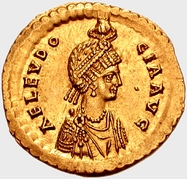
Aelia EudoxiaAelia Eudoxia
Wife of Arcadius, Eudoxia is famous for her battle with John Chrysostom, the bishop of Constantinople. He attacked the conspicuous luxury of her circle, and she used her influence among the clergy to have him deposed and exiled. She died from a miscarriage.

Theodosius IITheodosius II       (A.D. 402 - 450)
The son of Arcadius and Eudoxia, Theodosius II was proclaimed Augustus in 402, at the age of only eight months. Succeeding his father in 408, Theodosius was piously educated by his sister Pulcheria, whilst the Empire was effectively and efficiently ruled by his father’s Praetorian Prefect, Anthemius. The chief events of his reign were two successful wars against Persia, and the defeat of the usurper Johannes in the West, and the installation of Valentinian III in his place. A naval expedition against the Vandals failed, and Roman arms proved unsuccessful against Attila and the Huns, and Theodosius only obtained peace by paying increasingly large subsidies.
Aelia PulcheriaAelia Pulcheria
The eldest sister of Theodosius II, Pulcheria saw to all aspects of his education: moral, religious, and how to bear himself as Emperor. After the death of Anthemius she was the dominant influence on the young Emperor. She later married Marcian.
Aelia EudociaAelia Eudocia
The wife of Theodosius II, and the only real threat to Pulcheria’s dominance. She built up a faction of loyal officials around her, and tried to remove Pulcheria from power. The plan backfired, and Eudocia was forced to leave the capital through rumours of her adultery.
MarcianMarcian      (A.D. 450 - 457)
The son of a soldier from Illyricum or Thrace, Marcian rose through the military to political office at Constantinople. He was chosen as consort by Pulcheria, and succeeded Theodosius onto the throne. He immediately cancelled the payments to the Huns. He set about reforming the finances of the Eastern Empire, preventing extravagance and repopulating districts devastated by warfare. War with Huns was curtailed by the death of Attila in 453. Marcian generally ignored the Western Empire and did nothing to prevent its progress to destruction. He died from a disease, possibly gangrene, contracted on a long religious journey.
Leo ILeo I           (A.D. 457 - 474)
Born in Dacia c.400, Leo had been a military officer until becoming Augustus through the influence of the Master of the Soldiers, Aspar the Alan. Leo used soldiers from Isauria in Asia Minor to balance the German domination of the army, and thus thwarted Aspar’s plan to control the Eastern Empire. During his reign the Balkans were ravaged by vast movements of the Ostrogoths. The Huns also raided, and Byzantium was only saved by rebuilt and reinforced walls. A massive expedition against the Vandals in Africa failed expensively. Leo died of dysentery aged 73.
Leo IILeo II          (A.D. 474)
The grandson of Leo I, and son of Zeno and Ariadne, Leo II had been Caesar to his grandfather. He ruled independently as Augustus for about three weeks following the death of Leo I, and then acclaimed his father Zeno as co-Emperor. They ruled jointly for about nine months until Leo’s own death from natural causes.
ZenoZeno            (A.D. 474 - 491)
An Isaurian, at birth he bore the name Tarasicodissa, but after a successful military career under Leo I, he married Leo’s eldest daughter Ariadne, and changed his name to Zeno. Zeno was frequently unpopular during his reign, perhaps for his origins, though his practice of systematically selling offices did not increase his popularity with the aristocracy. Faced with a conspiracy by Verina, Leo’s wife, and her brother Basiliscus, Zeno fled the capital. Eventually restored to power, Zeno continued to be the target of plots and attacks. His involvement in the West was minimal, though he did declare Julius Nepos to be the Western Emperor, and continued to recognise him despite his exile in Dalmatia. Zeno himself died at peace on 9 April 491. The Western Empire having already disappeared, his successors as rulers of the Eastern Empire are generally accounted rulers of the Byzantine Empire.
Aelia VerinaAelia Verina
The wife of Leo I and mother of Ariadne. She originally supported her son-in-law Zeno, but eventually conspired against him. She fled to Isauria where she died in exile.
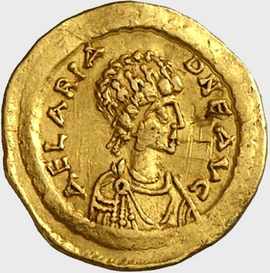
Aelia AriadneAelia Ariadne
The daughter of Leo I and Verina, and wife of Zeno. She became caught up in the struggle between her mother and her husband, and attempted to have the Isaurian general Illus killed in order to free her mother from prison.
BasiliscusBasiliscus              (A.D. 475 - 476)
Brother of Verina, and, had their coup been wholly successful, he was intended to replace Zeno as Emperor. On Zeno being forced to flee, he was proclaimed Augustus, but rapidly lost support. When Zeno gathered his support and returned, Basiliscus and his family were driven into exile, and subsequently starved to death.
Aelia ZenonisAelia Zenonis
The wife of Basiliscus, she bore him a son, Marcus. She died with her husband and son in exile at Limnae in Cappadocia.
MarcusMarcus
The son of Basiliscus, he was elevated by his father to co-Emperor in 476. He perished with his family in exile upon Zeno’s return to power. He is shown on the reverse of Basiliscus' gold solidi, seated in splendour, on right, alongside his father.
AnastasiusAnastasius            (A.D. 491 - 518)
In his attempts to restore and bring stability to the Eastern Empire, Anastasius reformed the entire currency, moving away from the old Roman denominations to a new Eastern standard. In numismatic terms, this is where the Roman Empire ends and the Byzantine Age begins; although it must be remembered that in historical terms there was a continuity from the reign of Augustus to the fall of Constantinople in 1453, in the reign of Constantine XI, and those who we call Byzantines still called themselves Romanoi, 'Romans'.


Back