The Year of the Four Emperors
and the Flavian Dynasty
(A.D. 68 - 96)


Lucius Clodius MacerLucius Clodius Macer
As legate in charge of Africa, he revolted in May 68 and cut off the grain supply to Rome. He raised legions with which to challenge for the purple, however his claims to power never gained momentum outside Africa, and Galba had him murdered on his own way to the throne.

GalbaGalba          (A.D. 68 - 69)
The death of Nero precipitated a period of anarchy known as the Year of the Four Emperors (69 AD). Galba, after a successful military career was governor of Eastern Spain. Taking advantage of the general revolt in the provinces, he marched on Rome, and, bribing the Praetorians away from Nero, he took the title Caesar. A mean and severe man, Galba was highly unpopular. His former supporter Otho took advantage of this unpopularity, and allying himself with the same Praetorians who had secured Galba's elevation, he had Galba murdered.
OthoOtho            (A.D. 69)
Otho had been a friend of Nero’s and governor of Lusitania. He rose to the throne after conspiring with the Praetorians to kill Galba, but the legions on the Rhine, led by Vitellius, refused to recognise him. After defeat in battle with Vitellius’ forces, Otho committed suicide on 16th April, after just three months as Emperor. His portraits reveal the wig that he always wore to hide his bald head.
VitelliusVitellius      (A.D. 69)
A friend of Gaius, Claudius and Nero, Vitellius had been proconsul of Africa. Galba appointed him governor of Lower Germany thinking to remove him as a rival. Vitellius used his great generosity to win over the troops who proclaimed him Emperor, and his defeat of Otho saw his title recognised at Rome. However, his claims were rejected by all the legions that had been fighting in the East; led by Vespasian, they advanced on Rome. Vitellius was persuaded to abdicate, but was captured, tortured, and executed on the 20th December. Sources record that he was greedy, lazy, and incompetent.
Lucius VitelliusLucius Vitellius
The father of Vitellius, Lucius was a provincial governor and administrator; he loyally served the emperors, and received the rare honour of becoming consul on three occasions. Known for his outstanding character, he had died of paralysis in AD 51.
The Children of VitelliusThe Children of Vitellius
Vitellius Germanicus, a son, was executed alongside his father. Vitellia, a daughter, lived on, and was later provided with a dowry by Vespasian.
VespasianVespasian   (A.D. 69 - 79)
The first of the Flavian emperors, and the first emperor not to come from an aristocratic family. Vespasian had risen by ability in the army; he led the conquest of southern Britain, and pacified Judaea. He is notable for the simplicity of his personal life, his sound economic policies, and the efficiency of his administration. He began construction of the Colosseum, and built or restored many temples and buildings in Rome. Most importantly, he restored peace and stability to the Roman world.
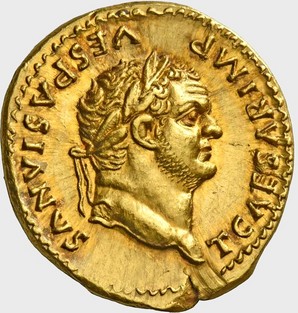
TitusTitus            (A.D. 79 - 81)
The son of Vespasian, and a great general who led his father’s armies in the final destruction of Jerusalem. He was universally popular and his reign was remembered as a happy one, despite the eruption of Vesuvius in AD 79, which destroyed Pompeii and Herculaneum, and the plague and fire in Rome the following year. Titus gave generous help to those who had suffered. Titus lived long enough to see the inauguration of the Colosseum, but passed away at a tragically young age.
Domitilla the YoungerDomitilla the Younger
Daughter of Vespasian and Domitilla the Elder, she was the sister of Titus and Domitian. She died like her mother before Vespasian became Emperor. Domitian honoured her with the title Augusta and issued coins with her portrait.
JuliaJulia
Although the daughter of Titus, and married to a cousin, Julia carried on an affair with her uncle Domitian, despite his marriage to Domitia. Becoming pregnant, Julia died as a result of what was believed to have been a enforced abortion.
DomitianDomitian     (A.D. 81 - 96)
The youngest son of Vespasian and the last of the Flavian emperors. A conscientious and dutiful ruler, Domitian campaigned in person on the Rhine and Danube, and his legate Agricola carried Roman rule far into Scotland. He grew increasingly tactless and autocratic, and his arrogant reign was perceived by the Senate as a ‘reign of terror’. Eventually a conspiracy was formed, probably involving his wife Domitia, and he was murdered and his memory condemned by the Senate.
Domitia LonginaDomitia Longina
The wife of Domitian, Domitia was tolerant of the Emperor’s infidelities, whilst her own affair led to divorce and exile. Eventually reconciled, she was later involved in the plot that overthrew Domitian, whom she survived to died peacefully many years later.
The Deified Son of DomitianThe Deified Son of Domitian
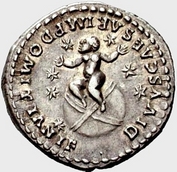
The only natural son of Domitian and Domitia. The child, the record of whose name has not survived, was born in AD 80, but tragically died in 83. His grieving father deified him and issued coins showing the infant among the stars.

Vespasian the YoungerVespasian the Younger
The lack of a natural heir forced Domitian to adopted a son. Vespasian and his brother Domitian were born to Flavius Clemens and Flavia Domitilla, but adopted by the childless Emperor. Their eventual fate is unknown, and no coins are attributable to the younger Domitian.


Back