The Julio-Claudian Dynasty
(31 B.C. - A.D. 68)


AugustusAugustus     (31 B.C. - A.D. 14) 
Great-nephew and adopted heir of Julius Caesar.  Gaius Julius Caesar Octavianus emerged as sole ruler and first emperor of the Roman world after defeating his rival Mark Antony in the civil wars that followed Caesar’s assassination. Awarded the name of Augustus after nominally handing power back to the Senate in 27 B.C., he continued to rule only as princeps (‘first citizen’) and cloaked his dominance of the state in Republican precedents. He succeeded like no purely military leader before him in maintaining the Roman empire in a stable state of peace. However, he added to his authority and titles, and set the pattern of civil and military powers that subsequent emperors were to follow for over two hundred years.
AgrippaAgrippa
Agrippa, a friend of Augustus, and the general that did the most to secure the throne for him. He married Augustus' daughter Julia and was the father of Gaius and Lucius Caesar, Agrippa Postumus, Julia and Agrippina Senior.
C. Asinius GallusGaius Asinius Gallus
A powerful politician who became a candidate to succeed Augustus. He married Tiberius' ex wife, Vipsania, and was suspected of fathering Drusus the Younger. Tiberius had him imprisoned in solitary confinement until he died.
LiviaLivia
The wife of Augustus and mother of Tiberius, and, like her husband, later deified. She promoted Augustus’ marital and social policies, but is also believed to have arranged the murders of several of her husband's opponents to further their dynastic ambitions.
Agrippa PostumusAgrippa Postumus
The youngest son of Agrippa and Julia, Postumus was of a cruel and brutish nature. This led to him being banished to an island where, following the death of Augustus, he was eventually murdered.
Gaius CaesarLucius CaesarGaius and Lucius Caesars
Grandsons of Augustus by Julia, the daughter of an earlier wife, and Agrippa his great general. Augustus pinned much of his hopes for dynastic succession on their young shoulders, and promoted them rapidly, but their tragically early deaths eventually forced him into the adoption of Tiberius.
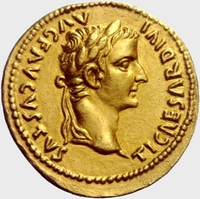
TiberiusTiberius       (A.D. 14 - 37)
The son of Augustus’ wife Livia by a previous marriage, Tiberius led many succesful military campaigns for Augustus, whose failure in his attempts to have one of his own descendants succeed him eventually forced him, in 4 AD, to adopt Tiberius and associate him in the last decade of his reign. Morose and lacking in confidence as a politician, Tiberius detested the servility and hypocrisy of Rome and withdrew into seclusion on the island of Capri. His steady and sober reign was damaged by his reliance on informers and favourites, especially the arch-manipulator Sejanus, which led to a series of damaging treason trials against many leading senators and potential rivals.
JuliaJulia
Julia was the only child of Augustus, by his first wife Scribonia. She was married to Agrippa and then to Tiberius.  Her notorious infidelities let to her imprisonment on the island of Pandataria, where she was eventually starved to death.
Nero Claudius DrususNero Claudius Drusus
Son of Livia by a former marriage and brother of Tiberius, he was the father of Germanicus, Livia Julia, and Claudius. A successful and popular general, he died following a fall from his horse.
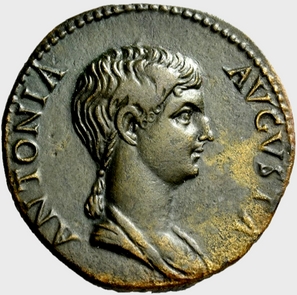
AntoniaAntonia
Antonia was the daughter of Mark Antony, and favourite niece of Augustus. She was the wife of Nero Claudius Drusus, and was the mother of Claudius, and grandmother of Caligula, who was later suspected of poisoning her.
Drusus the YoungerDrusus the Younger
Son of Tiberius by Vipsania. Despite a violent temper, Drusus showed promise in both the military and political arenas. After the death of Germanicus, Tiberius began carefully cultivating Drusus as his heir-apparent. He was poisoned by Sejanus.
GermanicusGermanicus
A great military leader; seen as a threat by Tiberius, this highly popular and cultured man was poisoned in Syria. He had nine children including the future emperor Gaius ‘Caligula’ and Agrippina theYounger, wife of Claudius.
Germanicus and Tiberius GemellusGermanicus and Tiberius Gemellus
The twin sons of Drusus the Younger and Livilla. Germanicus died in early childhood, but Tiberius Gemellus survived long enough to be named joint-heir with Caligula, only to be murdered by him soon after the death of the Emperor Tiberius.
Agrippina the ElderAgrippina the Elder
One of the daughters of Julia and Agrippa, and wife of Germanicus; she was the mother of Caligula. After her husband’s death, she was hostile to Tiberius whom she blamed. Eventually banished to an island, she starved herself to death.
Nero and Drusus CaesaresNero and Drusus Caesares
The elder sons of Germanicus and Agrippina. As the family of Germanicus fell under suspicion, Nero was exiled, and Drusus, after plotting against his brother, was imprisoned. Both were eventually starved to death.
Julia DrusillaJulia Drusilla
Daughter of Germanicus and Agrippina the Elder, and sister of Gaius. Rumours abounded that she was her brother's lover, and in AD 37, during an illness Gaius made her his heir. She died in 38 at the age of 22, and her brother had her deified.
Julia LivillaJulia Livilla
Youngest daughter of Germanicus and Agrippina the Elder. Rumours of prostitution and incest cloud her history. Involved in a conspiracy against Gaius she was banished. Recalled by Claudius, her personal or political activities resulted in her execution.
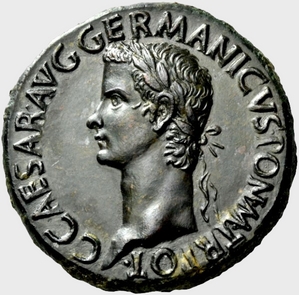
GaiusGaius           (A.D. 37 - 41)
Nicknamed Caligula ‘little boot’ after the miniature uniform he used to wear as a child in the legionary camps of his father Germanicus. Nominated as his heir in the will of Tiberius, Gaius was proclaimed Emperor by the Praetorians upon the Emperor’s death. Unsuited for rule by nature of his youth, he was 25, a reign that at first seemed bright after the gloomy rule of Tiberius, soon descended into capriciousness, tyranny and cruelty. A great builder, he was also, however, responsible to provoking war with the Jews. He was eventually assassinated by the same Praetorians who had originally set him on the throne.
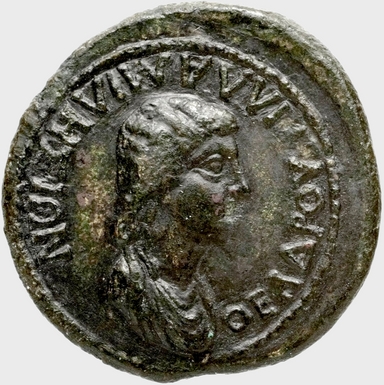
Milonia CaesoniaMilonia Caesonia
The fourth wife of the emperor Gaius 'Caligula'.  From humble origins, she was apparently neither 'beautiful nor young' when they married, but Gaius loved her 'passionately and faithfully'.
The Sisters of GaiusThe Sisters of Gaius
Agrippina the Younger who became the wife of Claudius; Julia Drusilla, possibly also the lover of Gaius, died of a fever that swept Rome; and, Julia Livilla, wife of the ill-fated general Varus, she died in a failed coup attempt.
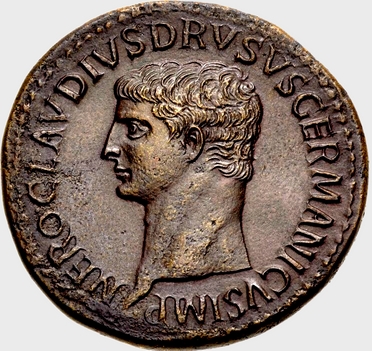
ClaudiusClaudius      (A.D. 41 - 54)
Scholarly, but hampered by physical disabilities, Claudius was a grandson of Mark Antony and brother of the popular Germanicus, who, after the murder of Gaius, became the last-surviving male of the Julio-Claudian family. The Praetorians who found him hiding in the palace made him Emperor by their acclamation. He was responsible for the invasion of Britain in AD 43, but was generally a weak ruler and too dominated by his wives. Claudius was eventually poisoned by his wife Agrippina the Younger, whose son Nero he had been persuaded to adopted.
Valeria MessalinaValeria Messalina
The great-granddaughter of Augustus, and married to Claudius to whom she bore a daughter Octavia and a son Britannicus. Notoriously promiscuous, she was eventually murdered by Claudius’ freedman Narcissus.
The Children of ClaudiusThe Children of Claudius
Claudius children by Valeria Messalina, his son Britannicus (centre) and Claudia Octavia (left), also his first child, a daughter Claudia Antonia (right), the child of an earlier marriage to Aelia Paetina, the sister of Sejanus.
BritannicusBritannicus
The son of Claudius and Messalina, but, whether though Agrippina’s influence or not, Claudius preferred his adopted son Nero, and eventually set Britannicus aside. Only months into Nero's reign, he was murdered, shortly before his 14th birthday.
Agrippina the YoungerAgrippina the Younger
When she married Claudius, she persuaded him to adopt her own son Nero, and to promote him ahead of his own son Britannicus. Agrippina later murdered Claudius, allegedly with a dish of poisoned mushrooms, to clear the way for Nero’s succession.
NeroNero            (A.D. 54 - 68)
Son of Agrippina the Younger, and adopted son of Claudius; Nero acceded at the age of sixteen. His reign began well under the guidance of wise counsellors like Seneca, but soon descended into violence and tyranny. He had Seneca, his mother, and his wife Octavia, the daughter of Claudius, all murdered. He was popularly held responsible for the Great Fire of AD 64, which he blamed on the Christians; he built a massive palace over the devastated area. He was obsessed with musical and dramatic competitions in which he scandalously took part. Eventually deserted by the Praetorians, and facing a revolt in the provinces, he committed suicide saying “What an artist dies in me!”
Claudia OctaviaClaudia Octavia
The daughter of Claudius and Messalina, and first wife of Nero. The popular and aristocratic Octavia bored Nero who had her banished, and when the Roman public complained, Poppaea persuaded him to sign her death warrant.
Poppaea SabinaPoppaea Sabina
The second wife of Nero. Beautiful and clever, Poppaea charmed her way topower. Her efforts to control Nero, however, led them to quarrel. Nero, in a fit of rage, kicked Poppaea in the abdomen causing her tomiscarry; she died as a result.

Statilia MessalinaStatilia Messalina
The third wife of Nero, she was far less flamboyant than her predecessor, and kept a rather low profile in the public eye. She was one of the few members of Nero's circle who survived his fall. Otho later promised to marry her himself before his suicide in AD 69.


Back