The Tetrarchies
(A.D. 284 - 324)


DiocletianDiocletian    (A.D. 284 - 305)
Of humble origins, Diocles, or Diocletian as he became, succeeding Numerian and Carinus, faced many problems, both internal and external. He decided they were too much for any single ruler to cope with, and therefore instigated the system of dividing the empire between two Augusti and two Caesars. With Galerius as his Caesar, he ruled the Eastern Empire, and introduced oriental court ceremonial in order raise the dignity of the Imperial office; he now was addressed not as First Citizen (Princeps) nor as military commander (Imperator), but as Lord (Dominus). Vigorous campaigning won a time of peace after 298 when he could reorganise the provinces, though the doubling of the size of the army and administration made a massive increase in the tax burden. In 305 troubled by his health, Diocletian abdicated, forcing Maximian to do the same, and retired to his palace at Salonae where he passed his time gardening and refusing invitations to return to power, until his death in 312.
 
MaximianMaximian    (A.D. 286 - 310)
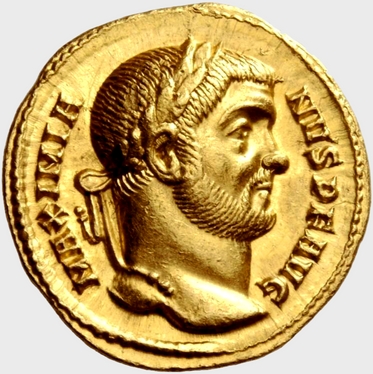
The son of a shopkeeper from Sirmium, but an excellent general, Maximian was called on by his old comrade Diocletian, first as Caesar in 285, and then as Augustus from 286. He had general control over the West of the Empire with Constantius Chlorus as his Caesar. He repelled invaders from Gaul, but lost control of Britain to the usurper Carausius. Compelled to retire by Diocletian in 305, he returned to power when his son Maxentius made him Augustus for a second time. He finally died by his own hand after failing in a revolt against Constantine I.
CarausiusCarausius
One of the lieutenants of Maximian, Carausius had been appointed to command of the Channel Fleet. He used captured booty to proclaim himself Emperor in Britain. He held the province from late 286 to 293, when he was assassinated by Allectus.
AllectusAllectus
Probably the finance minister of Carausius, he continued to hold Britain until 296, a period in which he engaged in ambitious building projects, especially in Londinium. He was killed when Constantius successfully invaded Britain.
CarausiusCarausius'Carausius and His Brothers'
All the rebels and usurpers laid claim to Imperial titles; Postumus had established a complete shadow empire in Gaul with officials, titles and honours in the Roman style. The cheek of the rebels was demonstrated by Vabalathus in Palmyra who minted coins with his own head and titles on the obverse and the Roman Emperor' head relegated to the reverse. The prize for confidence, however, goes to Carausius, who minted coins with the legend CARAVSIVS ET FRATRES SVI: 'Carausius and his brothers', shown right, which showed his own portrait alongside, and indeed superimposed, on those of Maximian and Diocletian.

 
GaleriusGalerius      (A.D. 305 - 311)
A herdsman born near the Danube, he rose through the army to be Diocletian’s Praetorian Prefect. He became Caesar and concentrated on military matters in the East. Raised to the rank of Augustus after the retirement of Diocletian and Maximian, he took control of the Balkan provinces and Asia Minor. Faced with the revolt of Maxentius, who had defeated Severus the other Augustus, he summoned Diocletian to resume the throne. When the old Emperor refused, he made his comrade Licinius an Augustus, an honour he was forced to extend to Maximinus Daia and Constantine. He died shortly afterwards from an agonising illness, which Christian writers attributed to retribution for his fierce persecution of the Christians.
Galeria ValeriaGaleria Valeria
The daughter of Diocletian and Prisca, she married Galerius in 293. After Galerius’ death she refused an offer of marriage by Maxentius. Fleeing from Licinius, she beheaded by a mob in Thessaloniki and her body was thrown into the sea.
Domitius DomitianusDomitius Domitianus
An usurper who made a bid for the purple in Egypt, possibly in resistance to a new tax edict. He maintained his position for less than a year until Diocletian brought his forces to bear.
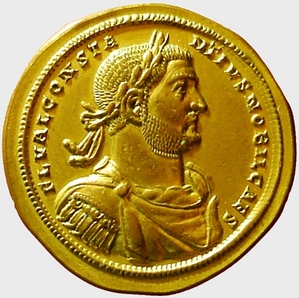
Constantius I ‘Chlorus’Constantius I ‘Chlorus’           (A.D. 305 - 306)
The former army officer and governor of Dalmatia, he was made Caesar by Diocletian and given control of Gaul. He defeated the usurper Allectus, and finally brought Britain back into the Empire. Raised to the rank of Augustus after the retirement of Diocletian and Maximian, politically he was badly outnumbered as both Caesars were loyal to his rival Galerius, and they had taken his son, Constantine, prisoner; crossing over to Britain to try to release him, Constantius died at Eboracum (York).
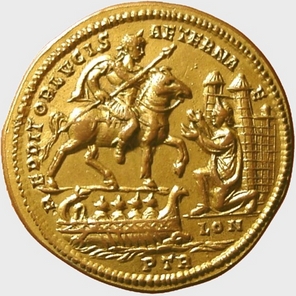
The Arras MedallionThe Arras MedallionThe Arras Medallion
Part of a treasure hoard found at Beaurains near Arras, France in 1922, this unique medallion depicts Constantius, mounted on horseback in the guise of a triumphant Emperor, holding a spear in one hand and a globe in the other. The inscription reads REDDITOR LVCIS AETERNAE ('Restorer of Eternal Light'). Before him is a city gate, identified as LON(dinium), which is approached by a Roman warship. Before the gate the personification of London is kneeling in submission. The medallion dates to 297, and was struck at Trier to commemorate the restoration of Britain to the Empire. It is therefore the earliest representation of London to exist.

 
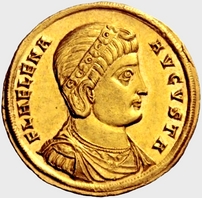
HelenaHelena
The first wife of Constantius Chlorus, and mother of Constantine I. Divorced by Constantius, she returned to the court when her son became Emperor. A noted convert to Christianity, she visited the holy land and discovered many relics.
TheodoraTheodora
After divorcing Helena, Constantius married Theodora, the step-daughter of Maximian, as a way of strengthening his political position. Together they had six children.
Severus IISeverus II   (A.D. 306 - 307)
An Illyrian military commander of humble birth, Severus was made Caesar in 305 with responsibility for Italy and Africa. When Constantius I died in 306 Galerius made him Augustus. The anger provoked by his attempts to take a census at Rome led to the revolt of Maxentius. Sent from Milan to suppress this uprising, but forced to retreat by desertions from his army, he was forced to abdicate. Maxentius had him taken to Rome, where he was later killed or forced to commit suicide.
MaxentiusMaxentius             (A.D. 307 - 312)
The son of Maximian, and married to a daughter of Galerius, Maxentius felt slighted at not being promoted to the rank of Caesar. Following Constantine’s attempt to proclaim himself Augustus, and provoked by Severus’ attempts to register the plebs at Rome, the Praetorians proclaimed him Emperor in Rome, and he recalled his father from retirement to assist him. Severus failed to suppress him, as did Galerius, and he made an alliance with Constantine in Gaul. Eventually the alliance broke, and Constantine marched on Italy. After several defeats, Maxentius died near the Mulvian Bridge, leaving Constantine in sole possession of the Western Empire.
RomulusRomulus
The son of Maxentius, he shared the consulship with his father, though only a child. He died young, probably in 309.
Domitius AlexanderDomitius Alexander
In charge of the province of Africa, when ordered to send his son as a hostage to Rome he rebelled. Despite possibly having allied himself with Constantine, when Maxentius sent forces, his rebellion crumbled.
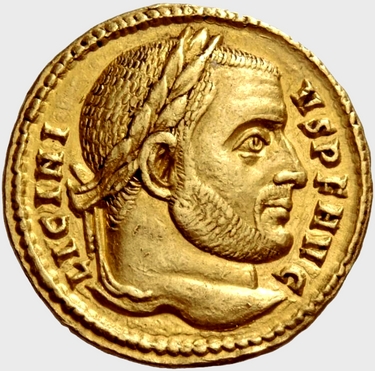
Licinius ILicinius I               (A.D. 308 - 324)
A comrade-in-arms of Galerius, Licinius was made Augustus by his close friend in 308. He refused to attack either Constantine in Gaul or Maxentius in Italy, but settled down to govern Pannonia. On Galerius’ death, the Augustus’ territories were divided with Maximinus Daia. Rivalry with Maximinus forced Licinius into an alliance with Constantine; this gave Licinius the power to defeat his rival and take possession of the East. It was an unhappy alliance however, and Constantine’s ambitions forced them into conflict. Licinius was eventually forced into conflict and defeated, and finally killed in the siege of Byzantium.
ConstantiaConstantia
The daughter of Constantius Chlorus and Theodora, and wife of Licinius. After Constantine had ordered the death of her husband and son, she continued to live at his court and received honours from him. She later converted to Christianity.
Licinius IILicinius II
Only an infant when, in 317, he was raised to the rank of Caesar alongside Crispus and Constantine II. His life was briefly spared when his father fell in 324, but not for long; he was executed in 326.
Valerius ValensValerius Valens
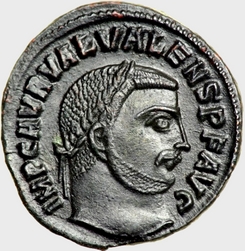
Previously a commander in Dacia, Valens was appointed by Licinius as his co-Emperor during his struggle for supremacy with Constantine. Following a defeat and settlement with Constantine, Licinius had Valens executed.
MartinianMartinian
During the second civil war with Constantine, Licinius again felt the need of a co-Emperor, this time a magister officiorum of his court. He had little success, and following Licinius final defeat, he was murdered on the orders of Constantine.
Maximinus II ‘Daia’Maximinus II ‘Daia’      (A.D. 310 - 313)
The son of a sister of Galerius, he had been promoted in the army, and made Caesar when his brother-in-law became Augustus in 305. Charged with governing Egypt and Syria, he was jealous when Galerius made Licinius Augustus ahead of him. His troops proclaimed him Augustus, a title recognised by Galerius in 308. Threatened by Licinius’ alliance with Constantine, he drew closer to Maxentius, but on hearing of the latter’s defeat he attempted to invade Europe. Defeated by Licinius, he fled and committed suicide at Tarsus.
Portrait of the Four Tetrarchs

Portrait of the Four Tetrarchs
Dating from around 300, this sculpture probably originally formed a part of the Philadelphion in Byzantium. Plundered by the Ventians when Byzantium was sacked in 1204 during the Fourth Crusade, it now occupies a corner of St. Mark's Basilica. Carved in Egyptian porphyry, a rare stone reserved for Imperial portaits, it shows heavily stylised portraits of Diocletian and his three colleagues, Maximian, Galerius and Constantius. Two of the figures have beards, probably the Augusti, and each Augustus is embracing his Caesar. The overall emphasis is upon unity and stability.
Portrait of the Four Tetrarchs


Back