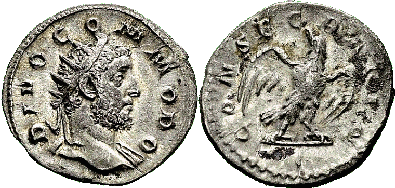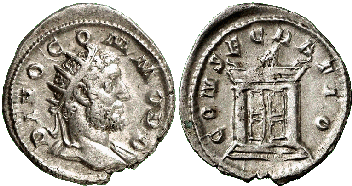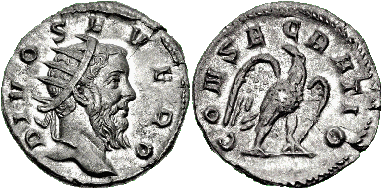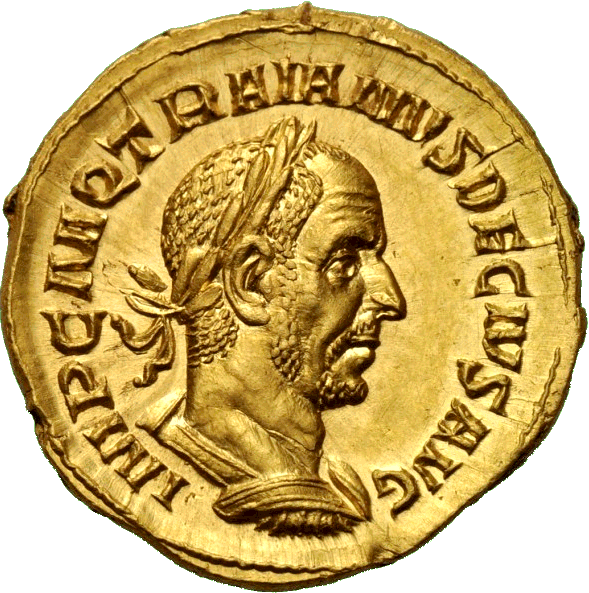
Upon his promotion to the imperial purple, the soldier-emperor Gaius Messius Quintus Decius chose to adopt the name Trajan into his official titulature. This signalled his intent to model his reign up that of the optimus princeps, and adopt a policy of returning to more traditional Roman values at a time of national crisis. Previous emperors had minted ‘restored’ issues, literally reissues, of coins of earlier emperors. This usually occurred when the emperor wished to be identified with a particular emperor or incident from the past. Not surprisingly, Trajan Decius issued a detailed series of coins commemorating his defied predecessors; however, these were not reissues, but entirely new designs. The selection of the rulers to be honoured in this way is, however, very unusual. Of the eleven divi chosen, Severus Alexander had never been formally deified, and Commodus had only been deified through political expediency rather than for any virtue he possessed as a ruler. The omissions appear just as strange to our eyes; Pertinax and Caracalla are perhaps understandable given the dubious nature of their reigns, but Julius Caesar, Claudius and Lucius Verus are all equally absent, and would seem to possess qualities worthy of emulation and promotion. These coins are neither excessively rare nor particularly valuable, but they throw an interesting sidelight on how Rome in the mid-third century viewed the earlier occupants of the Imperial title.
These coins are composed of only two types, usually summarized as Eagle and Altar. More fully they are: Eagle, standing r., head l., with wings spread; and altar-enclosure with double panelled doors, flames rising from the top of the altar, sometimes with horns visible on either side. Symbolically the eagle of Jupiter bore the deified emperor aloft to his place in the heavens, and an eagle was often released from the funeral pyre of the dead ruler as a visible symbol of his ascension; whereas the altar-enclose is associated with the cult of the deified emperor, and was the scene of sacrifices offered to the new god.
These issues were initially attributed by Mattingly and Sydenham to the mint at Milan, but more recent studies and the identification of various die-links mark them as the product of a single officina at Rome.