The Muses

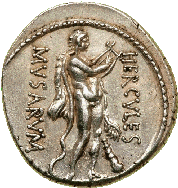
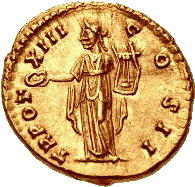
The Muses were the personifications of the arts and sciences from Greek and Roman mythology. They were considered the sources of the knowledge embodied in the poetry, lyric songs, and myths that were related orally for centuries in these ancient cultures. They were the daughters of Zeus (lat. Jupiter) and Mnemosyne, the personification of Memory. Originally three in number, the creative thought of generations of poets and mythographers expanded their number until nine became the canonical count, although the composition of the lists could vary. They were later adopted by the Romans as a part of their pantheon. However, they were never given the prominence in Roman iconography that they received in the Greek world. In the Hellenistic world the Muses were accorded great reverence, reflecting the importance the Greeks placed on their cultural achievements. At Alexandria, the Ptolemies had built a Mouseion, a Temple of the Muses, as a centre of study alongside the famous Library. Yet at Rome they never received a temple of their own at Rome, but shared a place of worship with a cult of Hercules in his role as Musagetes ('the Muse-leader'). Their place, as patrons of the arts, was largely fulfilled by Apollo who, like Hercules, also occasionally bore the cult-title of Musagetes.

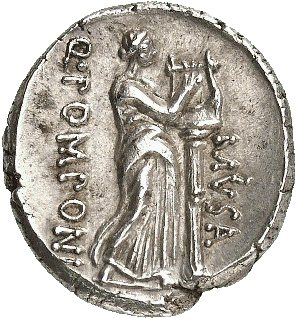
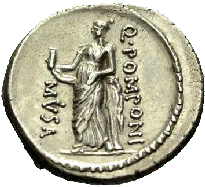
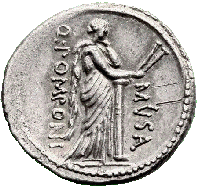
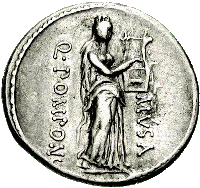
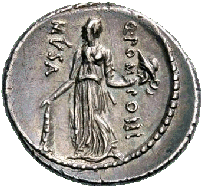
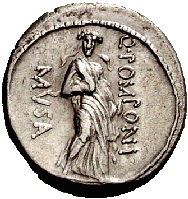
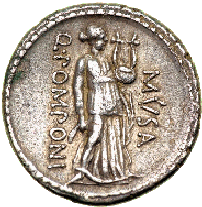
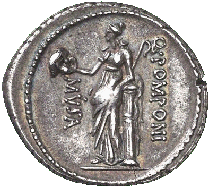
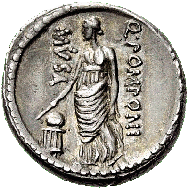
The Muses virtually never appear of Roman coins; the exception being the coinage of Quintus Pomponius Musa. Dating to c.56 B.C., or, as a recent revision of the dating of Republican coinage has proposed, c.65 B.C., this issue depicted each of the Muses with attributes or accessories indicating their identity. The motive for this display appears to have been nothing more than the rather obvious pun of 'musae' (Muses) and the issuer's cognomen, Musa.
Anonymous Bronze Tessera
The Muses (?)

Hercules Musagetes
Hercules Musagetes
Apollo Musagetes
Apollo Musagetes


The Muses by Q. Pomponius Musa
Calliope

Spoken of by Hesiod and Ovid as the 'Chief of all Muses,' Calliope presided over the arts of eloquence and epic poetry. Her name in Greek meant 'beautiful-voiced.'

Calliope is said to have born four sons to the war god Ares (lat. Mars) who became the eponymous founders of the four main Thracian tribes.

She is also recorded as having two famous sons, the legendary bards, Orpheus and Linus, fathered either by Apollo or king Oeagrus of Thrace. She taught Orpheus verses to sing, and was accounted by Hesiod the wisest of the Muses.
Calliope
Calliope
Clio
Clio
Clio

The muse of history, or, according to a few accounts, the muse of lyre playing.  Her name meant 'to make famous' or 'to celebrate.' Thus, she is sometimes referred to as 'the Proclaimer,' and is often depicted holding a scroll or a set of tablets.

She had one son, Hyacinth, the beautiful youth whose cult was celebrated at Amykles southwest of Sparta. The lad's father is variously recorded as Pierus, or king Oebalus of Sparta, or king Amyclas of Sparta, the progenitor of the Amyclae, the inhabitants of Amykles.

Other sources record her as the mother of Hymenaios, the god of the marriage ceremony, and some make her the mother of the poet Linus.
Euterpe

The muse of music, song and lyric poetry; her name in Greek meant 'rejoicing well' or 'delight.'

She was most often depicted holding a flute, and a few sources credit her with the invention of the aulos or double-flute, though most mythographers credited the invention to Marsyas the satyr.

Pindar and other accounts describe the Thracian king Rhesus as the son of Euterpe and the river-god Strymon.
Euterpe
Euterpe
Erato
Erato
Erato

The muse of lyric poetry, especially love poetry; the name Erato in Greek meant 'desired' or 'lovely,' and derived from the same root as Eros.

She is most usually depicted holding a lyre or a small kithara, a musical instrument particularly associated with Apollo.

A now lost Greek love poem, Rhadine, narrated her death and burial on the island of Samos, which, as Pausanias tells, became a site of pilgrimage for 'star-crossed lovers' who sought the muses aid and inspiration.
Melpomene

Initially the muse of chorus, as the genre developed, she became the muse of tragedy, and it is that role she is best known.  Her name meant 'to sing' or 'the one that is melodious,' and derived from melpomai which meant 'to celebrate with dance and song.'

She was the mother of several of the Sirens, the divine handmaidens of Persephone (lat. Proserpina). These were cursed by Persephone's mother, Demeter (lat. Ceres), when they failed to prevent her daughter's kidnap by the dread god of the underworld, Hades (lat. Pluto).

In classical poetry, it was traditional to invoke the muse Melpomene in order that one would be inspired to write beautiful verse.
Melpomene
Melpomene
Polyhymnia
Polyhymnia
Polyhymnia

The muse of sacred poetry, especially hymns, as well as dance, eloquence, pantomime, and agriculture.  Her name comes from the Greek words poly 'many' and hymnos 'praise.' She is also sometimes credited with being the muse of geometry and meditation.

She is usually depicted as serious, even pensive and meditative, and often holding a finger to her mouth, dressed in a long cloak and wearing a veil, and resting her elbow on a pillar.

On Mount Parnassus, a spring was sacred to Polyhymnia and the other muses; its water flowed down to Delphi where they were used by the Pythia for religious rites and divination.
Terpsichore

The muse of dance and choral singing, her name in Greek meant 'delight in dancing.' Her name has entered general English as the adjective 'terpsichorean' ('pertaining to dancing').

In some accounts she was the mother of the Sirens, including Parthenope ('maiden-voiced'), whose father was the sea god Achelous, or, alternatively, the river god Phorcys.
Terpsichore
Terpsichore
Thalia
Thalia
Thalia

The muse of comedy, her name in Greek meant 'the joyous,' or alternatively 'the flourishing,' and through this second meaning Thalia became the patron of idyllic or bucolic poetry.

According to ps.Apollodorus, she and Apollo were the parents of the Korybantes, the armed and crested dancers who worshiped the Phrygian goddess Cybele with drumming and dancing.

She is usually portrayed bearing a comic mask, crowned with ivy, and wearing boots. In many statues she also holds a bugle and a trumpet, both used to support the actor's voices in ancient comedy, and occasionally a shepherd's staff or an ivy-wreath.
Urania

The muse of astronomy, her name meant 'heavenly' or 'or heaven,' she was able to foretell the future by the arrangement of the stars. She is sometimes recorded as the eldest of the muses, and the inheritor of Zeus' majesty and power and the beauty and grace of her mother Mnemosyne.

By some accounts she is listed as the mother of Linus by Apollo or Amphimarus, son of Poseidon. Hymenaus is also sometimes said to have been the son of Urania.

Urania is often depicted in a cloak decorated with stars, and with her eyes fixed on the heavens. She usually represented with a celestial globe to which she point with a small staff or wand.
Urania
Urania

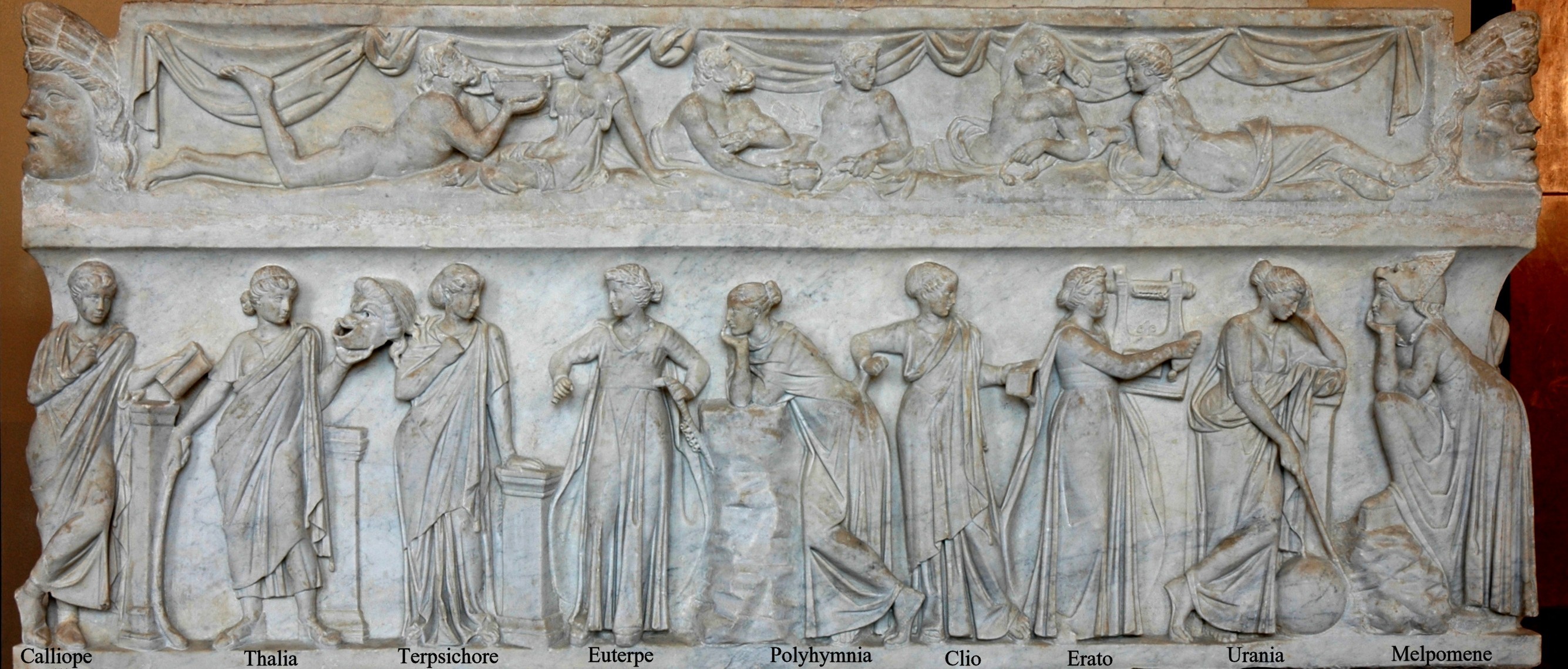
The nine Muses on a Roman sarcophagus, Louvre, Paris (2nd cent. A.D.)


Back