– The Competition That Defined Them –

Roman Politics and the Res Publica

          No aspect of Roman history is stranger than the political system that is called in English ‘the Republic.’  Its very strangeness has defied clear definition and explanation, and thus no aspect of the ancient world has given rise to so much literature, or excites so much learned discussion.  Polybius, a Greek scholar and politician of the second century B.C., began the process by attempting to explain to his Greek audience the political system he discovered in Italy during his exile there.  In a process that has been repeated by many commentators and analysists since, he sought to define the Roman world by reference to his homeland, and quelle surprise, only discovered a world that reflected his own.  Polybius defined the Roman system using the political language he was familiar with.  It was, he said, a mixed system, successfully combining elements of monarchy, the annual magistrates; oligarchy, the Senate; and democracy, the use of popular elections.  Yet, it is clear none of these terms precisely fitted the institutions they were applied to, and that much of the Roman system appeared inexplicable.  It proved difficult for Polybius to pin down where exactly where the division of power stood between these three areas, and he was forced to explain many elements of Roman practice as being ‘according to the Roman custom.’

          Since the Enlightenment, Western European scholars has seen the Roman Republic as a precursor to the development of their own political systems, and a source of insight on their own movement from monarchies to various levels of representative democracies.  Yet this is ironic, because the Classical tradition in Western Europe is largely built upon the legacy of that monarchy we call the Roman Empire, and the prestige and value we place upon the Republican tradition derives from that of the golden never-never land created by the diminished aristocracy, writing under Imperial rule, wishing for a time that had long vanished, and would never come again.

Marcus Tullius Cicero
fig. 1.  Marcus Tullius Cicero
          The writer who has exerted the greatest influence on modern discussions and reconstructions of the Roman Republic is Marcus Tullius Cicero.  Thanks to style of his writing and the elegance of his Latin, a vast quantity of the speeches, letters, and treatises of the silver-tonged and golden-penned orator have survived, and his works form a mighty corner-stone of the revival of learning since the Renaissance.  Yet, it might be doubted whether Cicero truly deserves to be praised for the humanitas that the scholars of the Renaissance perceived in his words.  A man lacking the clear political insight and firm moral compass to steer a steady, or even consistent, path through the turbulent political waters of the late Republic.  Even a brief perusal of whose works will show a man at least as vicious and venal as those he so charmingly, yet relentlessly, attacks.  Perhaps the least successful of Cicero’s works are those political treatises in which, in emulation of Plato, he attempts an analysis of the Roman system.  The result is a combination of historical fantasy, invention, and gossipy political reportage, all seen through a distorting lens of half-understood Greek political theory and philosophical ideas.  Eloquent, highly literate, and compelling, the Res Publica of Cicero bears comparison to the real political system of the Romans only by implication and temporal coincidence.

Romulus and Remus suckled by the she-wolf
fig. 2.  Foundation Myth – Romulus and Remus suckled by the she-wolf
          So, what is left after the majority of ancient and modern attempts at systematic explanation have been dismissed?  The answer is the res publica itself – the pattern of behaviour and interaction in which the Romans actually engaged.  The name meant ‘the public business.’  It stood in contrast to res privata and referred to those matters beyond the scope of the individual family or clan.  These were issues and decisions which demanded that the heads or leaders of these families and clans were brought together to discuss, to attempt to evolve a collective policy on, and, finally, to act upon, together.  Republican Rome was never totally unified or monolithic.  The image that we have received on a single voice at the centre dictating a defined and consistent policy to be applied uniformly across the Rome world comes only from the later Imperial period, and should not be sought, and will not be found, during the Republic.  The res publica was always a forum for argument and discussion – a collective policy might evolve and be implemented, but it was always over a plurality of opinions.  Unity might, briefly, be achieved in a crisis, but it would just as quickly dissolve once the pressing demand for it passed.

          Rome was formed by the agglomeration of tribes and families, clans and war-bands, villages and hamlets; firstly, in the neighbouring region of Latium, and then slowly extending outwards throughout the Italian peninsular, and eventually across the Mediterranean world.  The Romans’ own myths of their beginnings suggest the coming together of originally separate settlements on the hills of Rome.  I refer, of course, to the myth of Romulus and Remus, the notion of having twin founders setting up twin villages, and achieving unity only through an act of fratricide, is unique in folklore, and probably contains a historical core.  The later myth of foundation by Aeneas, was an attempt to the Romans to connect their history with the rich mythology of Greece, and, of course, cannot ante-date their interaction with the Greek world.  But even there, the idea of dual settlements is present, with Aeneas first settling in Lanuvium, and only later his descendants founding Rome.  Rome always remained open to immigration and settlement, and the community steadily grew.  The governing Patrician elite, however, were usually less willing to share their monopoly on political power.  But even here, powerful neighbouring chieftains like Lars Porsena of Clusium, or Titus Tatius from Cures, or the powerful Claudian gens from the Sabine country, might force their way in, and could even be welcomed.  The heads of the other native families, however, had to force the issue: this Plebeian aristocracy, that is major families from outside the ruling circle, had to lead their families and clans in secession from the State in order to force political recognition from the closed order of the Patricians, who regarded their position as exclusive, and theirs by birth-right.  This attitude of privilege, exclusivity and entitlement was then adopted by the Plebeian aristocrats as soon as they gained political recognition and equality, and continued to be held by those who occupied to the seats of power until the end of the Republic itself.
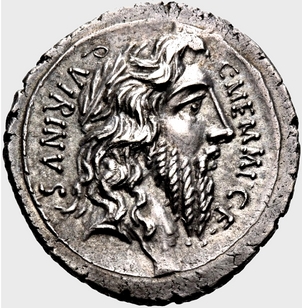
King Romulus
fig. 3.  King Romulus
King Numa Pompilius leading a sacrifice
fig. 4.  King Numa Pompilius leading a sacrifice
          The Romans were unanimous in insisting that during their early history the City had been ruled by kings.  But we should not be deceived into expecting a ruling family or dynasty like those of later Macedon or Ptolemaic Egypt.  The fragments of history deriving from this early period, if they preserve anything more than legends, show a heterogeneous collection of individuals, few of whom had any family connections.  Some like Romulus, the eponymous founder of the city, and Numa Pompilius, a priest-king who originated virtually every major Roman religious custom, are clearly personifications, invented to give a name and personality to historical processes and traditions.  Other kings might well be historical.  The rule of the Tarquins from Etruria may well reflect a genuine tradition, as it is hard to visualise a patriotic tradition that would preserve the memory of occupation by foreign kings unless such a circumstance was historical.  However, belief in the historicity of individual kings should not be taken to imply a developed or constitutional monarchy with all its attendant structures, institutions and offices.  Rather, we should visualise a strong and prominent leader of a clan, or group of clans, whether native or from the surrounding regions, who had managed to gain a temporary ascendancy over the Roman political system.  Such periods of individual control occurred at various times throughout the Republican period, and were considered, by their political rivals, to be the greatest evil to befall the state, and those that achieved such a position of domination were typically anathematised as kings and tyrants, and their political aims were slandered as an intention to found a new monarchy.  The expulsion of the last of the Tarquins by Lucius Junius Brutus and his colleagues may be historical, or it may be fiction, but it cannot be doubted that the native Roman aristocracy regained their ascendancy and the political control of the State, but it must not be forgotten that they had always been there, if not in authority, and that behind every ‘King’ was his ‘Senate.’

Lucius Junius Brutus
fig. 5.  Lucius Junius Brutus
          So how did this political system work?  Here again we must begin with res privata, and here too we must abandon all our concepts of constitutional and legal frameworks, definitions, and protections.  Roman society was entirely hierarchical.  Each adult male citizen stood at the summit of an individual pyramid of relationships.  Over those below him in that pyramid, he had almost complete control.  He could control their finances, property, marriages and relationships, and dispense justice to those under his potentia or ‘power.’  A simple farmer might control no more than his immediate family; a more prosperous land-owner might have several families working on his lands or in his businesses, he might have slaves working in his fields or in his homes, and he could also extend his control over the families of his children and near relations.  Those who looked to someone for food and shelter, welfare, benefits, protection, charity, employment, and discipline were all under his potentia.  The higher up the social scale, the wider the spread of one’s influence.  At the pinnacle of society, the aristocrats could have whole regions within their clientelae, and many hundreds of individual families under their authority, all connected in some way to the grandee at the summit of the pyramid, whether through family connections, financial obligations, through gratitude for services rendered or offered, or by way of historical relationships.  Status governed all interactions between Romans.  If the interaction was with someone of a lower status, then the possessor of higher status could usually decide the matter.  If two men of equal status clashed on an issue, and they could not settle the matter between themselves, then it must be taken before a man of higher status to decide the case.  Likewise, if a man of lower status wished to appeal the decision of a man of higher status, then the matter could be placed before someone of higher status than both parties.  Such a course could be perilous, as the appeal might be decided upon many factors other than simple justice, and the appellant might suffer for his daring at challenging the decision of his ‘betters.’  If a man, or one within his potentia, suffered hurt, loss, or insult from someone of lower status, then he was within his rights to retaliate or claim compensation through his own action.  If his assailant was of higher status than himself, then he must be prepared to set his case before a higher authority who could act for him, or shield him in his own efforts to seek restitution.  Within the homes, farms, estates, and territories, and wherever the authority of a Roman citizen extended, this was the Roman system.  This was res privata: the interwoven web of status and authority, of clients and patrons, of dominance and submission, of duty and protection, that governed the everyday life of the vast majority of Roman citizens.  Slaves, of course, had no recourse to the protections of this system, and were entirely subject to the potentia of their masters.

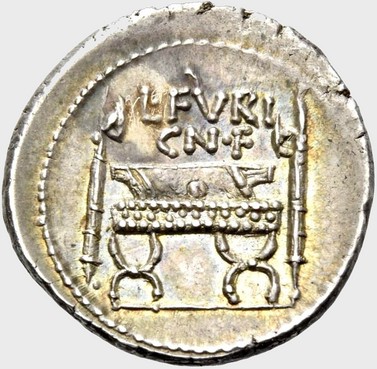
Curule Chair
fig. 6.  The curule chair of a Roman magistrate, flanked by the fasces
          These matters and relationships were the business of private life; politics, however, as the Greek name suggests, was the business of the city.  However, as the city and its challenges grew, its defence, organisation, construction, and trade all required more than ad hoc supervision.  So, the need arose for officials, or magistrates, with sufficient authority within the community to do what was necessary.  The Romans believed, as discussed above, that these functions had originally been carried out by the kings, and only later passed to civilian magistrates.  Stories from Rome’s early history suggest that her leaders were originally able to organise effective war-bands from their own relations, retainers and clients.  It also appears that the most important function of the early civilian magistrates was leadership in warfare.  Whether in defence against assault, or in raiding neighbouring peoples for booty, the need for a unified command in battle provided the impetus for the heads of the individual clans to accept the authority of just one of their number.  These early leaders were named praetors, which means ‘leader,’ and the authority invested in them was called imperium, or ‘right of command.’  The magistrate possessing imperium had the right to order all citizens, and this right was symbolised by the emblem of the fasces, which was carried before all magistrates possessing imperium, by attendants call lictors.  The fasces were a bundle of rods with an axe bound in the middle, and were said to represent the king’s authority administer corporal or capital punishment to citizens.  In the private sphere the head of a family had power only over those within the pyramidal structure of their potentia, but in public matters, imperium extended over all the individual heads and formed a pyramid of authority which subsumed all other individual pyramids; the true summit of the Roman hierarchy.

A consul, between two lictors
fig. 7.  A consul, between two lictors carrying the fasces, preceded by an accensus
          The praetors also fulfilled judicial functions within the City.  As we have seen, within a citizen’s home, or on an aristocrat’s estates, the master exercised his authority over all matters, and he could sit in judgement on all matters civil or criminal pertaining to those below him in the hierarchical pyramid of his potentia.  Within the City of Rome these matters were more complicated.  Lines of demarcation between areas of authority and property were blurred: a tradesman or a labourer might work for many masters; a thief might hide in a property belonging to a third party; and who was responsible if a crime or misdemeanour took place in the streets.  The dangers of a free-for-all, and of crimes being magnified by individuals trespassing on other’s areas of authority were clear to all.  Within the City, therefore, both civil and criminal offences became matters of public rather than private interest: res publica rather than res privata.  For those of the lower social classes, immigrant labourers, and slaves, justice remained, no doubt, summary, but here delivered by a public magistrate, rather than by an individual employer, landlord, or victim seeking revenge.  For those of higher rank, who had a public persona and status within society to maintain, public courts were established to ensure that justice was both done and seen to be done.

          Over time the need for additional magistrates forced a separation of functions: the praetors became exclusively law-officers, and their executive and military functions were assumed by the consuls.  The origin of this latter name has been lost, but this pair of annual officials became the nominal heads of the state.  When the Plebeian aristocracy was brought within the ruling structure, the tribunes, who had exercised a necessary organisational role, and acted as protection against Patrician abuses of power, were also integrated into the magisterial system, and came to play a powerful part in initiating or vetoing legislation in the interests of the lower classes.   Overtime, aediles were appointed to oversee the public games, celebrations, and other state occasions, and, as the state finances and tax system grew ever larger and more complex, quaestors, or junior finance officers, were added to the roster.

          It is clear from the first that these magistracies were exceedingly important, especially the praetor- and consulships, which conferred imperium.  To be acclaimed one of the leading men of the day, to give your name to the year, to pass laws which benefited your people, to curb injustices, to lead the armies in war, to bring home victories, and, above all, to be in control of events.  All these reasons and more led to fierce competition to obtain these posts.  At all times and on all occasions this competition was the primary business of the Roman aristocracy, and it was this competition that defined and shaped the res publica.

Casting a vote
fig. 8.  Casting a vote
          The method of gaining these positions was through election, but this should never give the impression that this was an entirely democratic process.  Rome was not democratic Athens, nor like any of the modern Western democracies that might make a dubious claim to be the direct descendants of Greece or Rome.  Rome was a hierarchical society, and all, apparently, from the lowest to the highest, agreed that this was the natural arrangement.  No political reformer in the history of Rome ever suggested implementing full democracy, or sweeping away the stratigraphy of the Roman state.  Votes were cast by individuals only within groups, and it was the vote of the group, decided by simple majority, that counted.  The groups were formed and ranked on the basis of wealth and property, and those who possessed neither had no vote.  The votes of these groups were cast in descending order of wealth, and the groups were so distributed that there were many more groups for the upper classes, and the masses of the poorer classes were forced into fewer groups.  This meant that if the upper classes stood together, and cast their votes in the same direction, then the issue could be decided before the lower groups even cast their votes, and it would not be necessary to call on them.  Was this system unfair? To our eyes, Yes!  Undeniably so.  Did the Romans consider this electoral weighting unfair?  No.  Again, I repeat, Rome was a hierarchical system, and it was considered correct that those at the pinnacle of society should exercise more authority than those below, but the benefits that accrued to those at the summit, were expected to flow downward and outwards.  I have spoken above of the pyramidal structure of the res privata, but the same structures extended over all aspects of Roman society.  The aristocrats gathered to themselves wealth, land, privilege, public offices, and influence.  They were the patrons, but their clientelae, those that received patronage from them, extended into every household in the land.  Employment, cash, loans, food-aid, support at law, compensation, recommendations, and promotions, all flowed downwards.  The individual could achieve little on their own, but by becoming the client of someone able to exert some influence over events, one could gain access to greater opportunities.  The support of a few dozen townsmen might gain a contractor the contract to erect a public building; a few dozen contractors and businessmen might support a local landowner to gain a place on a town council; and a few dozen town-councillors from the regions might journey to Rome to support a local magnate in his bid to gain a junior magistracy in the City, and to secure entry into the Senate.  At each level support and gratitude were given and received – the system was reciprocal.  So up and down the pyramid, at every level in society, Romans were competing for position and opportunities.  And at all levels, Roman politics was a popularity contest.  Everyone needed support, and privilege at the highest levels rested upon pyramids of support from the lower levels.  The aristocrats of Rome affected disdain for the lower classes, but all knew that their position depended upon the common welfare.  The aristocrat who too haughtily abused the poor, or who mocked and ignored their requests for support, would soon find his support dwindling – not because the poorer electoral groups would vote against him, for, though this would happen, as we have seen, if the upper classes voted together they could override any negative votes from the poorer classes, but because the popular clamour against a candidate would embarrass and shame his aristocratic support.  Whether or not competing for office themselves, the aristocrat stood at the summit of a pyramid of clients who themselves might be competing for offices, contracts, promotions, and support at every level of society, and a public display of misplaced support could undermine and devalue the support he could render in these other competitions.  It was always a sensitive business to judge the correct moment to render support, and to whom, and it required wisdom, experience and great nerve to choose the right moment to withdraw support from a candidate who carried weight and authority, and who might achieve a high position in society.

Citizens voting in the comitium
fig. 9.  Citizens voting in the comitium: one voter receives a ballot from an attendant below, another places his ballot in an urn
          Election to a magistracy was personal and individual.  A candidate might have a programme of action intended for his year in office, or he might offer nothing more than a much-respected name and pedigree; he might be active in office or lethargic; determined to affect events, or merely sleep-walk through his year; he might be warlike, or pacific; he might instigate political actions, or passively wait upon others; he might be supportive of the Senate’s agenda, or he might be hostile and obstructive.  The one thing a senior Roman magistrate never was, was a puppet: he was the one invested with power and authority; he held the imperium, and he alone decided how to use it, and how to conduct his office; he decided what he owed to those who has supported his election, and how he was to settle any debts he might have incurred.

          Participation in, and management of, this competition for offices and prestige was the business of the aristocratic families.  Here again, the metaphor of the pyramid proves extremely useful in visualising the structured relationships formed and maintained by these families.  Below every Aemilius, Fabius, Julius, or Metellus who sat in the Senate and sought the highest offices and commands, was a supporting pyramid stretching downwards and outwards throughout the Roman world; cemented by blood relationships, ties of patronage and friendship, with benefits and obligations flowing both downwards and upwards.  Each family worked over generations to build up their own pyramid of support, and to rise higher within the pyramids of those above them.  Whether fighting for a seat on a local town council, or seeking a consulship at Rome, each family competed at its own level, and sought the opportunity to rise higher.  Families would arrange the marriages of sons and daughters to forge connections with other families, and children were adopted both from and into other prominent families, all with the intention of bolstering the position of individual families.  Connections were made and broken, and support was lent and withdrawn, all in response to the overarching calculation of familial gain.  Over the generations, risks were taken, and positions gambled, in the hope of gaining political advantage.  A chance connection to a family on the rise could bring sudden and immense benefits, but a long-enduring and seemingly secure relationship to an established star at the moment of their political eclipse, could plunge a family into the political wilderness for a generation or more.  The game was ruthless, cruel, and entirely without sentiment.  The family strategists would calculate the prospects for an individual connection to a nicety, and the vagaries of personal sentiment could not be countenanced.  At every level, each family had resources to manage, ambitions to achieve, pitfalls to avoid, competitions to win, debts to incur, and obligations to fulfil.

          At the highest level, the goal was to become one of the rulers of the Roman State.  Access to these highest levels of political and military power brought with it access to the largest benefits both financial and political, and the greatest opportunities for patronage, and to build up a family’s pyramid of support.  Service to the state could bring enormous gains, but the hazard for those who climbed so far lay in the greater distance to fall, and the tiny number of places available at the summit of the pyramid meant that all those below could only achieve success by deposing those presently occupying the positions.  The general who failed in battle, the corrupt official who perverted the justice he was supposed to administer, or the greedy provincial governor who too mercilessly mulcted his subject peoples, risked a fall that could bring his family’s fortunes crashing down with him, and the struggles of generations might be needed to recoup the lost political ground.

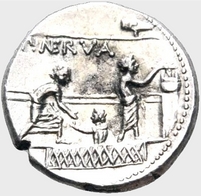
Curule chair within the temple of Vesta
fig. 10.  Curule chair within the temple of Vesta; urn to receive votes, and a voting tablet inscribed A C
          In referring to the failures or crimes of magistrates and officials, it becomes necessary to make some discussion of the Roman legal system.  Here one needs to abandon the clearly and carefully defined legalities of modern Western legal systems.  As we have seen, at the lower levels of the hierarchical Roman society, justice was usually summarily dispensed by someone understood to be in a position to decide the matter at issue.  In the countryside, where, incidentally, the majority of the population dwelt, private justice was the usual method of settling disagreement, of retribution and compensation.  In the cities, where boundaries were never clearly demarcated or overlapped, and where men of equal, or widely differing, status crossed paths on a daily basis, the state found it necessary to oversee the application of justice, and to prevent the conflicts and retaliations that could arise from private action.

          Under the leadership of the annual praetors, courts were established.  In simple matters the praetor could issue a decision by virtue of his imperium, or, if the case was more complex, he could empanel a jury to investigate the matter and to offer their verdict on the case.  Later, quaesitors were appointed to administer permanent, or semi-permanent, courts handling specific offenses or areas of the law.  Here again we must avoid comparisons with modern criminal law.  In a modern criminal case, the police investigate and build up a case against a suspect, and the trial involves a testing of that case, and its evidential support, against the law that the suspect is accused of breaking.  If the case fulfils the legal requirements for a guilty verdict, then the accused is punished, if not, then he is acquitted.  Roman Republican laws operated more like early medieval writs, and provided headings under which cases could be brought into court, and set out the manner of the proceedings, and the range of penalties.  So vague were these headings, that it was necessary for the individual praetors, on assuming office, to issue edicts detailing their approach to individual headings, and what manner of offences they would take cognizance of under specific headings.  These edicts built up over time to provide a useful commentary on the law and its application.

          The legal cases which dominate the literature and historiography of Republican Rome mainly concern prominent members of the aristocracy.  Of the crimes and misdemeanours of the lower classes we hear next to nothing, usually because they received summary judgement and justice, and were of little interest to the historians and lawyers of the upper classes.  But, where the aristocracy was concerned, all crime was, in a sense, political crime, and any accusation, prosecution, and / or defence were equally matters of political competition.  The technical legal issue of guilt or innocence was rarely at issue.  This is in stark contrast to the legal systems of modern democratic countries, which largely rely upon the separation of the judiciary and political office.  In republican Rome, however, the courts were just another theatre for political competition, and the whole proceedings and verdict were yet another test of political support and popularity.

A gladiatorial beast-hunt in the circus
fig. 11.  A gladiatorial beast-hunt in the circus – one of the many public entertainments
funded electoral candidates
          Again, in this arena, the malign influence of Cicero is strongly felt.  The survival of a copious volume of his forensic speeches provides us with our best evidence for criminal proceedings during the late republic, but, too often, the side of the case argued by Cicero has been accepted as the side of justice, and all the slanders and calumnies he heaps upon his adversaries have been accepted at face-value.  Yet Rome was ‘a slanderous community’ as Cicero himself reported, and allegations of vice, murder, arson, and sexual perversion were the stock-in-trade of oratory, whether in politics, prosecution or defence, and irrespective of political alignment or moral background of the individuals involved.  Cicero was simply the most adept and most effective exponent at wielding the cudgel of abuse and obfuscation.  His talents were of considerable value in the vicious world of high-level Roman politics, and his amorality and venality rarely saw him refuse a commission in which he saw an opportunity for success and self-advancement.  A man was not necessarily innocent because Cicero defended him, nor guilty of a crime or perversion because Cicero asserted it in the courts, Forum, or Senate.  These were not evidential statements delivered under oath in a modern courtroom, but political harangues, delivered in a court setting, but before a popular audience whose judgement and sentiment he was attempting to sway, and whose political support he was attempting to move away from the target of his words.  Accusations were made for many different reasons, guilt not necessarily being one of them.  Let us take for example the various leges de ambitu, which sought to curb electoral bribery.  Such legislation is entirely in accord with modern thinking, and we judge that anyone using bribery to influence an election should be punished.  This, however, is in a modern democracy, but Rome was not a democracy.  In the hierarchical, pyramidal system of Republican Rome, all candidates for office were expected to pass on the benefits to their clients and supporters.  A candidate gathered and ensured his support by distributions of patronage, whether financial, material, or in promises of future consideration and support.  This patronage was open, honest and practiced by all.  It was reciprocated by supports in elections, in the courts, and at public meetings in the Forum.  Electoral and legal success was dependant on the level of support you could muster.  The great man measured his political power by the hosts of clients who attended his morning receptions, or who accompanied him on his forays into the Forum or Senate.  The gaining of public office or military command opened up new sources of bounty and patronage to control, and to distribute, and new opportunities to increase one’s clientelae and garner greater political support.  All Roman politicians engaged in this behaviour, it was a regular part of the business of aristocratic patronage, and the lower classes depended on such open-handed ‘generosity’ as much as their patrons relied upon their support.  It was not a crime, per se, but in the perpetual arm-wrestle of political competition, there were always opportunities for losing candidates to cry ‘foul.’  The aspiring candidate who borrowed too heavily to fund the purchase of additional votes, the aristocratic grandee who too heavily lavished his support to gain the election of his nominee, the general who made too much use of the booty gained on military campaigns, or, simply, the unpopular candidate who gained election contrary to the ambitions of the established elite; in all these cases a prosecution de ambitu could be launched in an attempt, almost, to ‘appeal’ the result of the contest.  Likewise, a prosecution could be attempted in the hope of damaging a rival candidate’s electoral campaign.  In such cases guilt, or innocence, are largely irrelevant, they are tests – tests of popularity, tests of oratorical skill, and tests of aristocratic support.  A prosecution might be ventured against the most secure, bluest of all blue-bloods, with no hope of success, but a skilfully handled prosecution would stand to the credit of the up-and-coming orator-politician, and might put enough of a stain on a great man’s escutcheon to loosen his grip on his political support.  But an inept prosecution, perhaps aimed at a target too high to reach, or one who’s support was too solid to move, would embarrass and damage the prosecutor and his backers.  It was always a gamble.  It was a test of status, the secure or rising man could bring to his defence the leading men of the day to testify to his character, and call upon the service of one of the star orators, like Cicero, to present his defence.  The defendant who lacked support, or whose star was on the wane, was vulnerable.  Prosecutions were rarely completed, for if condemnation appeared certain, then a condoned withdrawal by the defendant, and a period in exile would follow in the most serious cases.  Yet, there was no value in random prosecutions, or in prosecutions aimed at non-entities, and such political malice would reflect severely on the prosecutor.  The political class could unite to protect one whom they regard as being prosecuted unjustly.  It was close rivalry that brought prosecutions, and the more closely matched the political opponents, the more likely they were to resort to the courts as an extension of their competition.  It was common for defeated candidates in elections to prosecute their successful rivals by alleging that they had only succeeded through bribery.  It was, of course, true that all successful electoral candidates relied for their success, at least in part, on their more successful management and distribution of patronage.  Such cases would provide an opportunity for the political class to pass judgement on the successful candidate and his electoral strategy.  If it fell within bounds, and the character of the candidate was generally approved of, the support would appear in the court, and the defendant would be acquitted to enter into his office.  However, the outsider who had resorted to too lavish distributions of capital could find himself ejected from office, and the aristocratic establishment would rest secure, and feel that justice had been served.  The criterion of success in all cases was aristocratic support, and a candidate could largely behave as he wished, provided he could carry with him enough support to also gain victory in the test at law.  I state, once again, that guilt or innocence had little, if anything, to do with the legal result.  In most cases, we simply have no access to the objective facts; in the histories of the period, or in the pages of Cicero, we hear the accusation, usually in the most hysterical terms, and with the most lurid details, but of the actual evidence, hardly a word.  It was simply not that important, it was the arrival or withdrawal of aristocratic support that brought about acquittal or condemnation.

          Following a year in office, it was customary for the retiring consuls and praetors to embark for a term as governor of one of the increasing number of provinces.  Within his province, the Roman magistrate was a virtual monarch, and indeed, backed by Roman military might, superseded all native rulers and officials.  The main priorities were the maintenance of peace, and the gathering of tribute and taxation.  The opportunities for exploitation, extortion and corruption were manifold, tempting, and extremely lucrative.  A successful governorship could bankroll any future political career, fund the extension of one’s clientelae and political support at home, and be invested in the purchase of more extensive land holdings in Italy – the true basis of all wealth and position at Rome.

A silver cistophorus of Cicero in exile
fig. 12.  A silver cistophorus from Laodiceia ad Lycum bearing Cicero’s name, minted during his own period of exile in Cilicia
          Again, this was not necessarily criminal behaviour.  The governor was not paid, nor was he provided with an administrative staff; his administrators and entourage came from his own family and friends.  He had no claim on the state for reimbursement and travelling expenses, so it was up to his own devices to ensure that he did not return crippled with debt.  Of course, some provinces were more lucrative than others, and some governors more successful, or more rapacious, in the gathering of revenues.  This could give his political rivals at home another chance to cry ‘foul,’ as the governor-politician returned to the game at home with coffers bulging with potential patronage, and a greatly increased opportunity to secure lasting political benefits.  The rapacious governor would frequently be followed, at a short distance, by the disgruntled representatives of his late province, coming to with appeals to the politicians of the capital for compensation and redress.  Whether they were listened to, and whether anyone cared to take up their case, had little to do with the justice of the case, and everything to do with the political support carried by the accused governor, and the relative scale of his depredations.  The right to enrichment at the provinces’ expense was a part of aristocratic privilege, and one of the major rewards that compensated for the crippling expenses involved in seeking and maintaining office, and was therefore fiercely protected by all who might have profited themselves in a similar situation, or who hoped to do so in the future.  Verres, the late governor of Sicily, though not a major political figure at Rome, but apparently guilty of the grossest despoliations, found it necessary to defend himself against such a prosecution.  It was to Verres’ great misfortune that the young Cicero, then an up-and-coming young orator making his way in politics, perceived his vulnerability.  It was a case of political calculation.  Verres did enjoying some noble support, but the presence in Rome of a noisy delegation from Sicily would lend powerful ammunition to the prosecution.  Here was a target worth taking aim at: if Cicero lost the case, he might not suffer any major political damage, yet, if he won, the case would be high-profile enough to confer major advancement.  The surviving speeches, elaborated for publication, show Cicero’s skill in such cases, the litany of charges and accusations, the skilful interweaving of actual charges relating to events in Sicily, and gross political slanders.  Each passage falling like a hammer-blow on Verres’ political support, until sufficient damage was done, and the support withdrew, lest it too be tarnished, and the former governor fled into exile.

The Rostrum – the speaker’s platform in the Forum
fig. 13.  The Rostrum – the speaker’s platform in the Forum, with a bench for the orators, and mounted with the rostra, or beaks of ships, which gave it its name
          Roman politics, and the set-pieces of aristocratic competition, always took place before a live audience, and the audience participated in the show, and the principals, like good actors, too their cues from the audience’s reactions – public shows of support, and its equally public withdrawal; insults delivered in a public forum required equally public rebuttal or reciprocation; patronage had to be seen to be delivered, and public debts seen to be honoured.  Whatever political deals might be hammered out in the backrooms of the senate-house, or in a magnate’s private chambers, they had to be delivered and carried through in public, and the public would pass their judgement upon all such machinations.

          Modern historians and political commentators often speak confidently of the Roman Republican constitution, and one recent book, in its opening pages, referred ridiculously to this constitution as a ‘document.’  No such ‘document’ has ever existed.  The Romans, at least during the Republican period, did not think in such terms.  There was no constitutional framework for framing such a text, nor legal superstructure to ensure its implementation.  It is true that Sulla, Caesar, and the later Triumvirs all assumed dictatorial powers ‘res publica constituendae,’ and this phrase is frequently written about in constitutional terms.  However, the phrase meant nothing more than the restoration, or setting-up aright, of the public business; i.e., after a period of disorder, the restoration, to its usual working order, of the normal activity of the state.  It was in this functional sense that the Romans thought of and defined the res publica: a complex of activity and interactions that lay within, and gave shape to, the public sphere of action.  There was no legal framework to prescribe this activity; offices came with no detailed job description nor contract.  The individual, in a sense, defined his role for himself.  Energetic men brought energy to their position and great activity might ensue; lethargic men might slumber through their year in office, with little to show save the prestige of office-holding.  It was the right of every man to manage his business in the way that he saw fit.  In this way, it was simply an extension of the res privata into the public arena.  If a need for action was perceived, it was a matter of election, not legislation.  The political classes would select one of their number, after suitable competition we may be sure, and give him sufficient public authority to fix the problem as he saw fit.  This public authority, the Roman imperium, in practice meant freedom of action: the right to order, or to compel; to requisition and command; to use force, or to persuade, as the wielder decided, to achieve what he thought was necessary or right within his provincia: his area of command or sphere of action.   A provincia might be a geographical region, but it could equally be a military command, or a specific task such as the construction of a road or an aqueduct.  There was a danger that such areas of command could overlap and cause conflict, but in practice this was avoided.  The imperium of the consuls at Rome superseded all other authorities, but, unless they were commanding armies, was rarely exercised outside the City, whilst, the imperium of provincial governors did not extend beyond their geographical regions, and military commanders could not enter the City and retain their command.  With no framework, legal or constitutional, to restrict or control this freedom of action, the only restraint was through precedent, and the mos maiorum – the ‘way of the ancestors,’ the control exercised on individuals by custom, modesty, and traditional usages.  How much pressure this social restraint could exert depended upon the boldness, imagination, and courage of the individual concerned.  As Rome expanded, and the scope of required action grew beyond all precedent, Rome never altered its method of dealing with issues or tackling problems.  When the issue of piracy grew insufferable during the first century B.C., the Roman people’s response was to select the first citizen of the day, Pompey, and invest him with an authority covering the entire Mediterranean Sea, and extending into every province on its shores.

Gnaeus Pompeius Magnus
fig. 14.  Gnaeus Pompeius Magnus – Pompey the Great, with the emblems of Neptune
          The judgement of success or failure, of compliance or abuse, of the acceptability, or not, of a magistrate’s use of his imperium was weighed not against a constitutional or legal standard, but by the judgement of his political contemporaries.  Incompetence, abuse of provincials, extortion, or corruption of power could strip one of the necessary supports, and place the individual under immense pressure as he faced political repercussions, and the prospects of prosecution through the courts.  Equally, too great a success in office, and the accumulation of too much prestige and rewards, would engender political jealousy, and one could become the target of attacks designed to reduce the political imbalance threatened.  Thus, the political competition of the res publica regulated the use or abuse of imperium.  The Roman laws de maiestas, usually translated as ‘treason’ laws, are frequently quoted in these situations.  But it is important to understand what the ‘State’ is whose majesty was being threatened.  It was not a supra-individual, nation-state defined by a strict legal framework and constitutional instruments, as in the modern world, but the res publica, that freely-interacting melee of competing aristocrats.  What threatened the res publica was not a technical breach of highly detailed legislation, nor an abuse of power: a stepping over clearly-defined guidelines – there were no such restrictions or guidelines.  The only guide was what was acceptable within the day by day, year in, year out, competition that defined the State.  The individual who grew too mighty, too free in his use of power, too successful, too popular, could destabilize the free operation of this competition; skew the game; undermine his rivals’ ability to compete in the elections or courts; and potentially permanently eclipse the competition – this was the ‘treason.’  Individuals  who achieved such domination, or were feared to be attempting to do so, were accused at aiming at the destruction of the state, the murder of their rivals, and the replacement of the res publica with regnum – that despised kingship from which the Romans believed they had freed themselves at the beginning of their history.  Such claims need not be believed, they are no more than the cries of ‘foul’ raised by rivals at the perceived ascendancy of a hated competitor, but magnified through the distorting lens of Roman political oratory.  There is no evidence that any major Republican politician aimed at the destruction of the res publica before Octavian actually accomplished it, and he was exceedingly cautious to hide is monarchy behind a façade of republican forms.  Marius, Sulla, Pompey, and Caesar were all Republican magistrates, no matter how grossly inflated their individual powers and commands.  What they sought was dominatio, not revolution.  And because of their personal domination, their opponents branded them enemies of the state.  Whether the dominant party had good or bad intentions, was beneficial to the res publica, or damaging to it, was irrelevant to their contemporaries, and modern historians should be wary of using to long-lens of historical hindsight to decide such issues.  Whether they achieved useful reforms, or simply aggrandized themselves; whether they politely masked their domination, or nakedly paraded it before the sullen eyes of their competitors, what mattered was that their domination hindered their rivals freedom to compete.  The Romans called this right to engage in the competition libertas.  The definition of liberty in Republican Rome would be alien to Rousseau, Locke and Voltaire, and equally strange to Plato and Demosthenes.  It was not a universal concept, nor one that applied equally to all free citizens, it applied only to the aristocratic participants in the competition of the res publica – those individuals at the summits of all those hierarchies or pyramids that met in Rome to compete to shape and control the public business.  Under the later Imperial rulers, the emperors would advertise the libertas brought about by their reigns, and the use of the slogan on the coinage might appear to imply a universal sense, but the freedom referred to was the freedom of a subject from the threats of warfare and foreign invasions, or the dangers posed by rival claimants for the throne.  When Brutus and Cassius led the revolt against the dominatio of Caesar, it was because they feared he aimed at monarchia, and in order to restore libertas.  It was the natural reaction of aristocrats unable to compete – the crime was the political domination, and the plaintive cries were for the restoration to traditional privilege.

The goddess Libertas
fig. 15.  The goddess Libertas
 on a coin of Gaius Cassius
          Caesar, for his part, had crossed the Rubicon with his Gallic armies and marched on Rome because he felt that his dignitas was under threat from his political rivals.  The phrase is not easy to unpick, but essentially it means the right to the rewards of prestige and political office that he felt he had earned.  His rivals feared that the rewards would amount to personal and political dominatio, and vociferously and violently opposed any privilege he sought or was offered, and threatened to assail him in the law courts upon his return.  The rights and wrongs of the case are impossible to decide, and largely irrelevant to understanding in the actions of those involved.  What is important to observe is that the actions and language of both sides were entirely customary, but skewed and magnified as a result of the extraordinary military command held by Caesar, and the vast resources and benefits he had accrued through his victories.

          The idea of political parties was entirely unknown to the Romans.  Certainly, the Romans formed factions around charismatic and powerful individuals, or around particular families or clans, and their connections.  These are better described as affinities rather than parties.  The idea of commitment to a manifesto, or a party-line, that transcended both the specific issues and individual careers, was alien to the fiercely individualistic and dynastic Romans.  Factions formed around personalities, but they also formed over individual issues.  It was a regular occurrence for individuals and factions to combine to secure the election of a favoured candidate, and yet to divide over the passage of specific items of his legislation.  Factions were formed and broken for specific purposes, and for the benefit of the combining elements.  Cicero briefly considered forming an alliance with Catiline to aid their mutual election to the consulship: for a novus homo, no matter how skilled at oratory, the combination with a patrician politician would be an asset in establishing his electability.  These arrangements implied no common platform or manifesto, they were simply a matter of electoral mechanics: two individuals pooling their limited assets and support for joint benefit.  Rarely did an individual candidate, no matter how lofty his family background, possess sufficient resources and electoral support to ‘go it alone,’ and such political aloofness would be unattractive to the senatorial classes, for whom the bartering and horse-trading of political support was the very essence of their position.

          Aspects of the political language of the period, have been seized upon modern scholars to imagine a bipartite political structure.  Firstly, there were the optimates, ‘the best men,’ consisting of the legitimate, conservative, old men of authority and responsibility in the Senate.  Ranged against them were the populares, the rabble-rousing, radical demagogues who sought to undermine the established order by passing legislation at the popular assemblies.  Such a clear division, however, is a gross misrepresentation of the reality, and, in truth, individual politicians were never entirely optimate nor polularis.  The two terms are distinguished by the relative importance of the Senate in the passing or blocking of individual pieces of legislation.  Traditionally, a politician proposing a law would seek senatorial approval for his measure, during which procedure the legislation could be passed, amended, or blocked.  A measure, once passed, would be taken by a magistrate to be ratified by a popular assembly, the comitia centuriata.  By contrast, populares legislation was drafted by, or for, one of the Tribunes of the Plebs, and if passed by the Assembly of the Plebs, the concilium plebis, would become law as a plebiscita, the ‘will of the Plebs.’  In this latter process, the senatorial elite played little part except by registering their disapproval at the public meetings.  But, whichever method of passing legislation was chosen, the principal actors were usually members of the aristocracy, including the vast majority of the Tribunes; many a scion of the Plebeian nobility began their political careers in the tribunate, and spread their political ‘wild-oats’ by proposing and vociferously supporting popularis legislation, before settling down to a traditional, optimate, senatorial career.  Likewise, the bluest of blue-blooded Patrician senators might have recourse to the support of the tribunate, and popular legislation, to move a measure for which he lacked support amongst his peers.  Also, unlike other magistrates, the Tribunes possessed the right of veto, and could, in the name the people, block all other legislative activity.  This prerogative meant, in effect, that it was essential to have popular, or at least tribunician, support for any legislation to be passed.

The triumph of Lucius Cornelius Sulla
fig. 16.  The triumph of Lucius Cornelius Sulla
          As in all other matters concerning Roman republican politics, the issues resolve into a popularity contest.  A senator proposing legislation needed the support of a majority of his colleagues in the Senate, the good-will of a magistrate to take the bill forward before an assembly, a measure of popular support to ratify the legislation, and the support, or at least indifference, of the college of Tribunes to prevent them exercising their veto.  It is clear, that the greater the consensus amongst the political aristocracy and the public on an issue, the greater the chances of a measure becoming law.  Since the earliest day of Rome, the Patrician aristocracy had tended to show a united front towards any threats to their position of power and privilege, and the biggest concession gained by the Plebs as a result of the ‘Struggle of the Orders,’ besides the admission of the Plebeian aristocracy to the highest magistrates, was the right of the Plebs to pass legislation in their own interest, that would be binding on the state as a whole, and not just on their own order.  In time, the Plebeian aristocracy came to share the aims and values of their Patrician colleagues, and the necessity of this legislative outlet remained vital.  However, the presence of Plebeians within the Senate must have brought with it the knowledge and experience of this alternative legislative procedure, and a willingness, in extremis, to resort to it.  A senator, lacking sufficient support within the Senate, if he could be certain of enough popular support, might call upon the services of a tribune to pass the legislation for him through the concilium plebis.  This action, though it would bring about his abuse as a polulares, would imply no party change, and, on another issue, he might himself be ranged amongst those abusing a colleague for availing himself of such a recourse.

          From the time of the Punic wars, the issue of military commands was one where the popular assemblies played an increasing role.  The people adored a successful general, and would wish him to be voted into further commands or higher office.  The Senate, on the other hand, tended to fear their popular ascendancy, and dreaded the political advantages that accrued through their successes.  The Senate tended, therefore, to jealously block further appointments to those who had already achieved such victories, and to be tardy or niggardly in ratifying the settlements of the returning generals.  The Plebs, however, showed themselves willing to make good the Senate’s deficiencies, and grant the triumphant general what he seemed to have earned.  The tension, thus created, came to dominate the politics of the late Republic, as the scale of commands, and the political settlements required by victories, grew out of all proportion to the ability of the political machinery at home to cope with.  This was not an issue of parties, but a clash over a particular issue, and the general, returning to the Senate, might well side with the conservatives in the next vote on a provincial command or financial measure, despite his having benefitted from popular agitation and legislation.
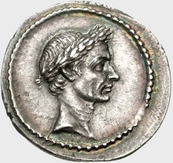
Gaius Julius Caesar
fig. 17.  Gaius Julius Caesar
          The closest Rome ever came to a political party was the radical-conservative faction headed by Cato Uticensis at the close of the Republic, who sought to overcome the political manipulations of Pompey, Crassus, and particularly Julius Caesar.  This tight-knit group of optimate politicians sought to block legislation from the ‘triumvirs’ in the Senate, to prevent their passing legislation through the popular assemblies by promoting their own nominees to the tribunate, and, by pooling their political support, to gain election for their own nominees in opposition to the candidates of the three popular leaders.  The recourse, by such an optimate grouping, to tribunician politics demonstrates, at least by the late Republic, that the two legislative strands had largely become synonymous in Roman politics.  Political necessity meant that a politician had to be able to master both routes to gain his ends, and expediency forced his opponents to likewise fight him in both arenas.  Here again, the major issue was one of personalities and political power.  Cato and his faction feared the concentration of political advantages in the hands of the ‘Triumvirate,’ and their ruthless exploitation of popular support to subvert the political landscape at Rome.  That is, at least, how they saw matters.  However, Cato’s faction was equally ruthless and unscrupulous in its machinations to block the triumviri and to promote its own narrow interests.  It was their manoeuvring that eventually forced Caesar to march on Rome, but their ultimate political weakness was shown by the necessity of their having to turn to Pompey to lead the fight for their faction in the resultant struggle.  This weakness, however, should not blind us to their equal share of responsibility for the ultimate destruction of the Republican system.  For all its arrogance, pride, and ruthless competition, Roman aristocratic politics was built upon compromise and consensus-building.  No man could long dominate the state without support, and such temporary positions of supremacy were quickly swept away once their rivals coalesced into a coherent opposition.  Continued success meant building up as wide a basis of support as could be achieved: quid pro quo, by offering support one gained support – over generations clans and families created such networks that, hopefully, ensured success.  Temporary eclipse and political failure could be borne, if, during that period of obscurity, the sure foundations of future success were being laid.  Cato and Caesar were much alike in their pride and inflexibility.  Neither could stomach personal eclipse, and arrogantly saw their personal political ascendancy as equating with the survival of the State.  The success of Caesar in the Civil War was not the triumph of the better cause, nor was it a moral vindication of his right to fight for his dignitas, it was simply that, after ten years hard fighting in Gaul, he was in possession of the greatest fighting army ever assembled in the Roman world.  If Caesar considered his case right, it was because ‘might made right.’

          From that point onwards, the free political competition of the old Republic was curtailed.  The generals, whether Caesar or his successors, could always force through their legislations, or demands, over the objections of the political establishment at Rome.  And, whilst the struggle for political office continued unabated, the prize of political power was no longer obtainable.  That prize the soldiers reserved for themselves.  And when Augustus seized power over the State, no matter how he might cloak his authority in republican guise, it was as a military dictator that he ruled the world.

© Paul Dinsdale, 2019


Back